Nikon’s Roots | Vol. 21

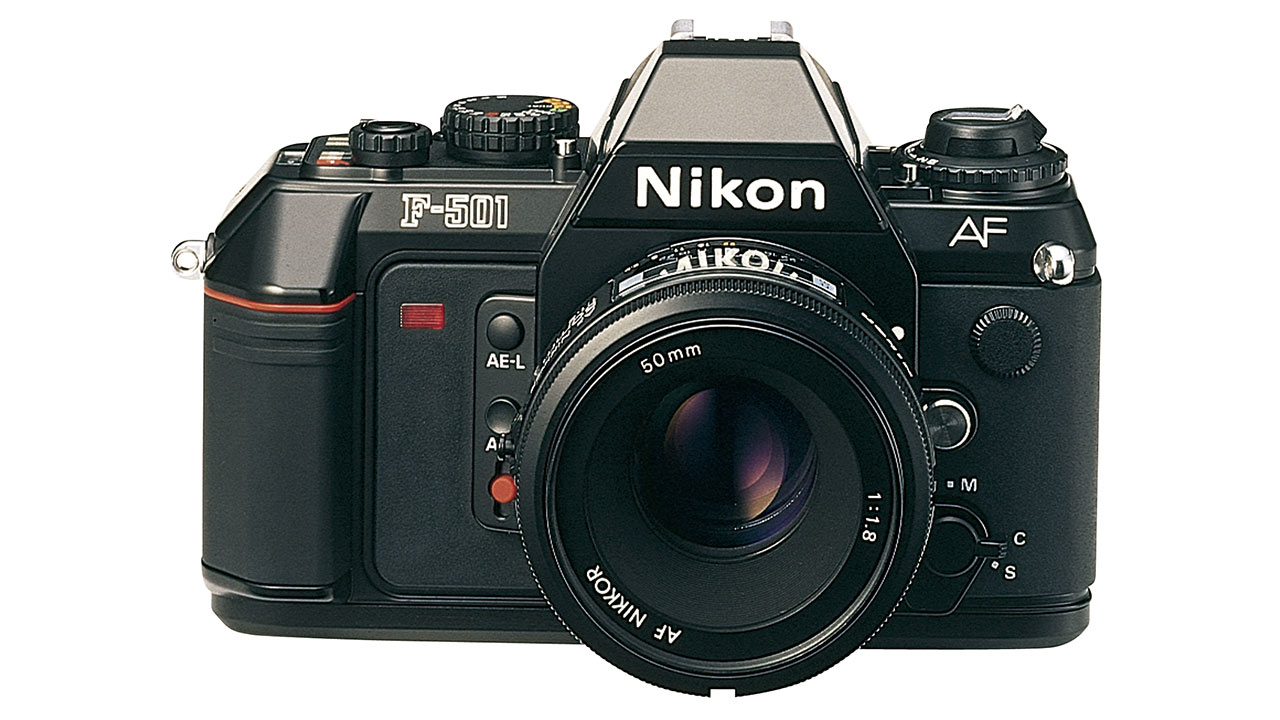
Nikon’s Roots is our deep dive into the history of Nikon. With their retro-styled Nikon Z f camera making waves in 2023, along with their best-selling Z8, we will take a good look at the history and genealogy of Nikon. These articles are written originally in Japanese by lecturer and former Nikon employee Kenji Toyota. This episode of Nikon’s Roots is Volume 20 – the Nikon F-301 and F-501AF.
Nikon F-301 and F-501AF: Fully automatic SLR cameras
As mentioned in the last episode, the full automation of cameras—that is, the incorporation of AE, AF, and motorized film winding and rewinding—was pioneered by 35mm lens-shutter cameras, but in the 1980s, the momentum finally began to appear in 35mm SLR cameras as well. The pioneer of this trend was probably the Konica FS-1 from 1978. Focusing and rewinding were manual, but it lacked a winding lever or knob, and it had an auto-loading mechanism for film, giving it a fresh appearance. This was followed by the Contax 137MD (1980) and Canon’s T series (1983). Then, with the addition of phase-detection AF in the Minolta α7000 (1985), it can be said that the full automation of SLR cameras was completed.
Following this trend, Nikon also developed a new product line of models, incorporating various automation functions. The first models in this line were the Nikon F-301 and F-501AF.

Electric winding system
The film winding motor for the Nikon F-301 and F-501AF is built into the winding spool, and the rotation of a rotating shaft protruding from the bottom of the camera is transmitted via gears to the mirror’s up/down movement and the aperture control mechanism. In the case of the F-301, the power source is four AAA batteries, which are housed in the bottom of the camera.
As a result, the tripod mounting screw has been relegated to the edge of the body. Battery replacement is done by removing the bottom cover and replacing the batteries in the holder, but a holder and bottom cover for AA batteries were also provided and could be used. In contrast, the F-501 uses AA batteries as standard, but AAA batteries can also be used by changing the holder and bottom cover.
Autofocus Function
The difference between the F-301 and F-501AF is that the former is a manual focus camera, while the latter is an autofocus camera; other specifications are almost identical. Regarding autofocus, unlike the Nikon F3AF, it uses the same phase detection method but employs a Honeywell TCL module. The sensor is located in the standard position at the bottom of the mirror box. Since the Nikon F-401, released the following year in 1987, used its own internally developed AF sensor, the use of the TCL module might have been a temporary measure until their own internally developed sensor was completed.
Motor in Lens vs Camera Body?
A major problem when implementing autofocus (AF) in SLR cameras is whether to place the AF drive motor in the lens or the camera body. By around 1985, numerous attempts had been made to implement AF in SLR cameras, but at that time, DC motors were practically the only AF actuators available, and every manufacturer struggled with where to place such a large motor. Considering the need to avoid making too many changes to the camera body, placing it in the lens seemed the most reasonable option, but as mentioned in the section on the Nikon F3AF, the inability to properly manage the space for the motor resulted in the lens barrel becoming an odd shape with only the motor section protruding from the cylindrical shape.
Lens-Mounted System
When Nikon was developing the F-501AF, they initially proceeded with a lens-mounted motor system similar to that of the Nikon F3AF. Then the Minolta α7000 appeared. This camera cleverly solved the “mumps problem” of lenses by placing the AF drive motor in the camera body and transmitting power to the lens via a coupling shaft in the lens mount. Seeing this, Nikon also made a major change in its policy to a body-mounted motor system.
Controversially Implemented Internally
This change in policy apparently caused considerable debate within Nikon. I’ve heard that there was particularly strong opposition from the development engineers. One reason was that development of the F-501AF was well underway, so there wasn’t enough space to house the motor inside the body. Thanks to the development team’s efforts, they managed to fit the motor into the winding mechanism of the mirror box, and the policy change was implemented, allowing for an in-body motor. However, this forced the motor to be placed vertically, resulting in a complex mechanism that uses a screw gear to convert the direction of rotation to a right angle.

However, they didn’t abandon the in-lens motor system entirely; they kept a system configuration that allowed for both, and this was later utilized in AF-I and AF-S lenses, as well as G lenses.
AF Nikkor Lenses
The autofocus-compatible interchangeable lenses released simultaneously with the Nikon F-501AF included a 50mm f/1.8 prime lens and two zoom lenses, 35-70mm and 70-210mm. Nine more lenses were added later that year, rapidly expanding the lineup.
In the case of other companies, both Minolta and Canon changed their lens mounts when introducing autofocus to their SLR cameras. Changing the lens mount carries the risk of alienating users, but in the case of major technological innovations like autofocus, it is easier to gain user acceptance by explaining that it is necessary to implement the new technology. Both companies successfully used this opportunity to go ahead with changing their lens mounts.
Adding Electronic Contacts to the Nikon F Mount
However, Nikon did not do that. While keeping the aperture and flange back distance the same as the Nikon F, they improved the electrical contacts introduced in the Nikon F3AF to enhance information transmission between the body and lens. Each lens was equipped with a CPU, and information was exchanged via digital communication with the body’s CPU. With the previous mechanical linkage, if the type of information to be transmitted increased, it was necessary to add new levers or pins each time, and older lenses that did not have these means could not use the new functions. However, by adopting this digital communication method, it became easy to add or change information. Support for older products could also be done with firmware updates, and convenience was greatly improved.
The Ai AF Lenses Coupling Mechanism
Furthermore, Ai AF Nikkor lenses were equipped with mechanical coupling mechanisms such as exposure meter coupling guides, allowing them to be used without problems as Ai-S lenses even on older bodies. Although they did not have the so-called “crab claw” (a type of mounting mechanism), Nikon’s service department would install one upon request, allowing the latest AF lenses to be used with coupled exposure meters even on older Nikon F-mount Photomic and Nikkormat series cameras. This level of dedication to users of older products is a characteristic of Nikon.

Originally written in Japanese by Kenji Toyoda | Profile
Mr. Toyota was born in Tokyo in 1947. He worked for Nikon Corporation for more than 30 years, designing single-lens reflex cameras and working in electronic imaging. He will then teach as a part-time lecturer at the Department of Photography, College of Art, Nihon University until 2021. Current positions include Fellow and Auditor of the Photographic Society of Japan, Cooperating Committee member of the Japan Opto-Mechatronics Association, and judge of Japan Camera Museum’s “Japanese Historical Cameras.” He has written numerous books, including “Professor Toyoda’s Camera Mechanism Lectures” (Nippon Camera Co.), and “Cousins of the Nikon Family” (Asahi Sonorama).