Nikon’s Roots – Volume 20
Nikon’s Roots is our deep dive into the history of Nikon. With their retro-styled Nikon Z f camera making waves in 2023, along with their best-selling Z8, we will take a good look at the history and genealogy of Nikon. These articles are written originally in Japanese by lecturer and former Nikon employee Kenji Toyota. This episode of Nikon’s Roots is Volume 20 – the Nikon L35AF.
The Nikon L35AF – responding to the decline of SLR cameras.
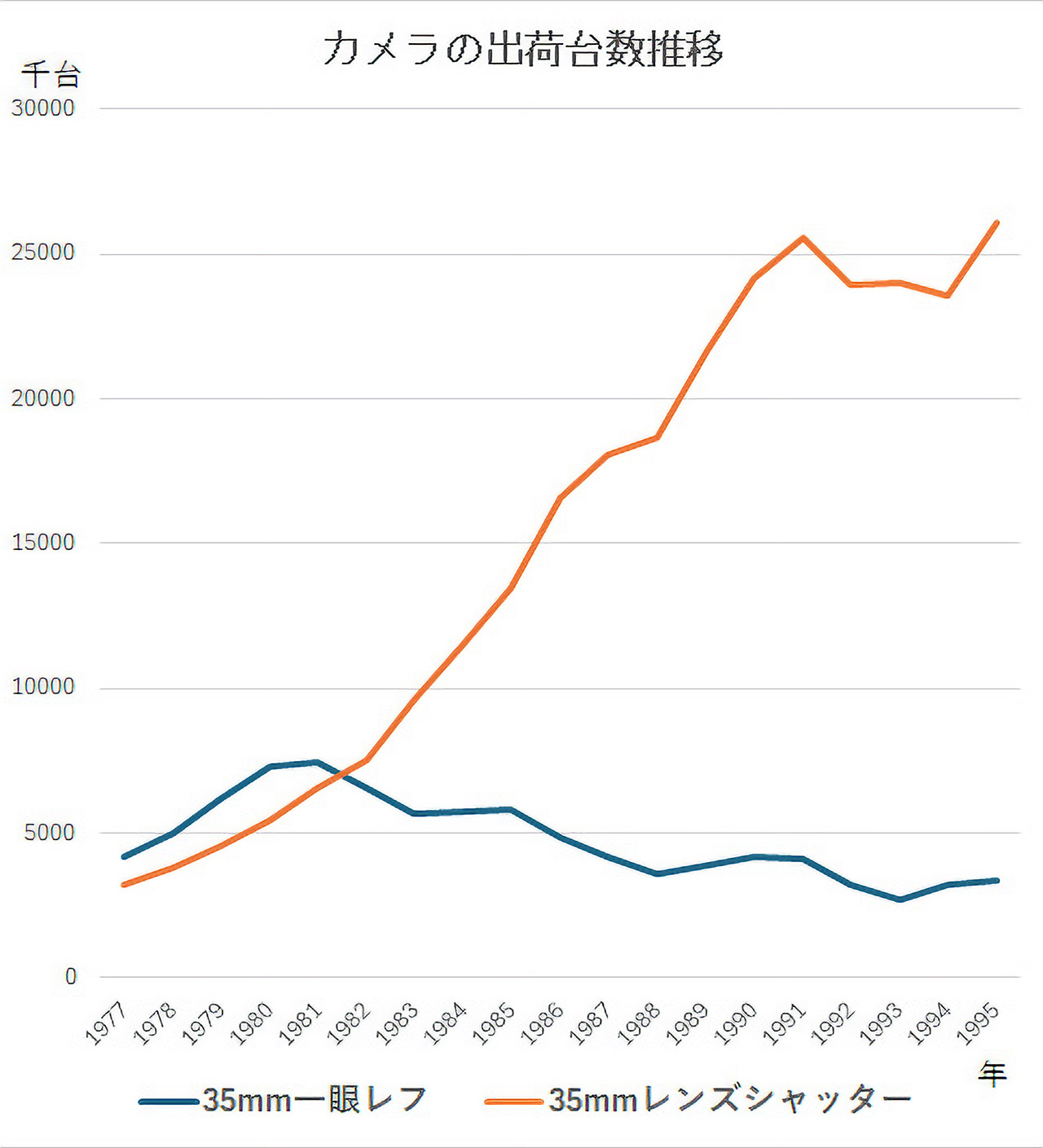
Following the introduction of the Canon AF35M (Autoboy) in 1979, 35mm compact cameras entered the era of fully automatic operation. With automatic exposure, autofocus, and automatic film winding and rewinding powered by an electric motor, plus a built-in flash, fully automatic cameras that allowed users to simply press the shutter button appeared from various manufacturers and swept the camera market. And it was 35mm single-lens reflex cameras that bore the brunt of this trend.
(Click image to enlarge)
SLR Shipments Decline from 1981
After peaking in 1981, SLR camera shipments steadily declined. Despite the interchangeable lenses, users preferred compact cameras—which allowed them to take beautiful photos with just the press of a button—over large, heavy, and expensive SLR cameras. The rapid rise of 35mm compact cameras and the decline of SLRs are somewhat reminiscent of the later relationship between smartphones and compact digital cameras.
Nikon, which had previously been a manufacturer specializing in SLR cameras, could not simply stand by and watch the market situation unfold. They decided to enter the 35mm compact camera market, and the first model they released in 1983 was the Nikon L35AF.
The five SLR camera companies and compact camera
At the time, the 35mm SLR market was divided among five manufacturers known as the “SLR Five”: Nikon, Canon, Minolta, Olympus, and Pentax (Asahi Optical). Of these, Canon, Minolta, and Olympus had long been producing 35mm lens-shutter cameras, and only Nikon and Pentax did not have a compact camera in their product lineup. Perhaps realizing that they could not survive on SLRs alone, these two companies successively entered the market for fully automatic 35mm compact cameras around this time. Pentax entered the market in 1982 with the Autron, so Nikon ended up being the last to enter.
Barriers to entry and differentiation
Nikon had previously attempted a lens-shutter SLR with the Nikkorex 35, but it wasn’t very successful. Compared to that time, entering the market this time was not particularly difficult. Active autofocus was a new technology for Nikon, but it was already readily available in module form.
As a differentiating factor in entering the market, Nikon focused on its photographic lenses. At the time, the standard for this type of fully automatic compact camera was a 38mm f/2.8 Tessar-type lens with 3 elements in 4 groups, but Nikon opted for a Sonnar-type lens with 4 elements in 5 groups, and shifted the focal length to a wider 35mm. This lens was well-received by users, but in its successor, the Nikon L35AF2, it reverted to a 3 elements in 4 groups Tessar-type lens, presumably to cut costs.
Incidentally, this lens is called “Nikon Lens” and not “Nikkor,” and with a few exceptions, all subsequent Nikon compact cameras also use the “Nikon Lens” name. This was also the case with the interchangeable lenses for the Nikon EM a while ago, suggesting that Nikon has a strong attachment to the “Nikkor” name.
The Nikon L35AF nickname in Japan
The Nikon L35AF was nicknamed “Pikaichi” (meaning “top-notch”). I’ve heard that there was opposition from upper management within Nikon at the time, but it was also a topic of conversation among the public, with people saying, “Not that arrogant Nikon.”
Actually, it was fashionable at the time to give nicknames to compact cameras. It probably started with the Konica C35EF (1974), which was advertised as “Pikkari Konica” to emphasize that it had a built-in flash. After Canon, as mentioned earlier, called its AF35M “Autoboy,” other manufacturers also began to release their compact cameras with nicknames.
“Pikaichi” followed suit, and for a while, Nikon’s compact cameras that came out afterward were also given the name “Pikaichi,” such as “Pikaichi 2,” “Pikaichi Mate,” and “Pikaichi Tele.” “Pika” indicates a built-in flash, and there are examples of other companies using this name as well, but the original etymology was the meaning of the 20-point card in Hanafuda (Japanese playing cards).
These are the highest-scoring cards, such as the pine and crane or the cherry blossom and curtain. Having one of these 20-point cards is called “Pikaichi,” and by extension, it means “the best.” Well, in any case, it may not be considered a very polite word.
This nickname didn’t catch on overseas
This custom of giving nicknames also existed in overseas markets. However, “Pikaichi” didn’t work overseas. Therefore, export models were given different nicknames starting with the successor model, the L35AF2. The North American version was called “One Touch,” which later changed to “Tele Touch,” “Fun Touch,” and so on, depending on the model variations.

Development of the Pikaichi series
The Nikon L35AF had a sibling model, the Nikon L35AD, sold concurrently. This model had a back cover with a date imprinting mechanism, and in the domestic market, this model was actually the main one, while the L35AF without the date function was mainly for export.
This line of fully automatic compact cameras continued to develop, with variations including dual-focus lenses, zoom lenses, and waterproof models. Even after the SLR market revived with the advent of autofocus, this line remained an established pillar of Nikon’s camera business.
At that stage, in the early 1990s, they stopped using the “Pikaichi” designation. Perhaps they decided that there was no longer a need to create a sense of familiarity with a nickname, given the emergence of distinctive lens-shutter cameras such as the Nikon Mini, Nikon 35Ti, and 28Ti around that time? Interestingly, the “…Touch” nickname for overseas markets continued, and even into the 21st century, alongside the Coolpix series of digital cameras, film compact cameras with names like “One Touch Zoom” and “Lite Touch Zoom” appeared.
Originally written in Japanese by Kenji Toyoda | Profile
Mr. Toyota was born in Tokyo in 1947. He worked for Nikon Corporation for more than 30 years, designing single-lens reflex cameras and working in electronic imaging. He will then teach as a part-time lecturer at the Department of Photography, College of Art, Nihon University until 2021. Current positions include Fellow and Auditor of the Photographic Society of Japan, Cooperating Committee member of the Japan Opto-Mechatronics Association, and judge of Japan Camera Museum’s “Japanese Historical Cameras.” He has written numerous books, including “Professor Toyoda’s Camera Mechanism Lectures” (Nippon Camera Co.), and “Cousins of the Nikon Family” (Asahi Sonorama).