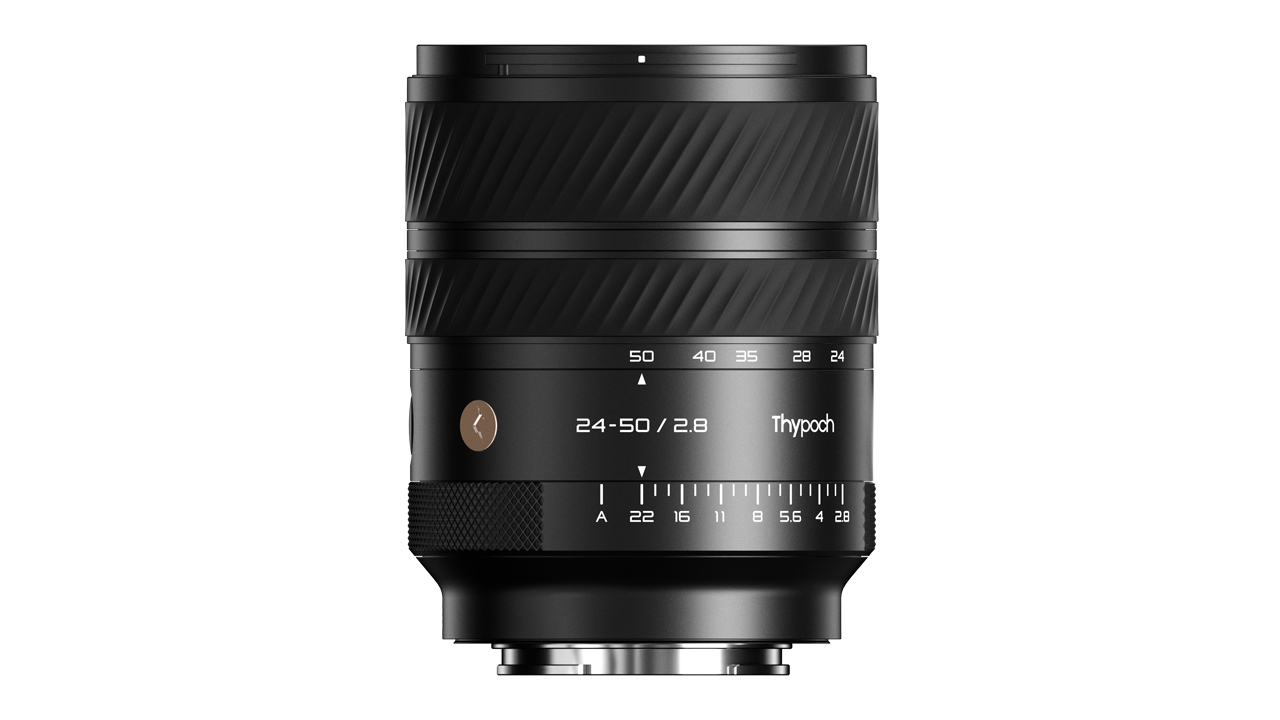
Thypoch announced the “Voyager 24-50mm f/2.8,” the first full-frame compatible autofocus zoom lens from a Chinese optical brand, and also the company’s first AF lens. It is scheduled for release in early June 2026.
Built for Sony E-mount mirrorless cameras, the Voyager employs an inner zoom mechanism that keeps the lens length constant across the entire focal length range, achieving a consistent aperture of f/2.8 from 24mm to 50mm.
Thypoch Voyager 24-50mm Features
Three prime lenses in one lens
Photographers who use prime lenses typically carry 24mm, 35mm, and 50mm lenses. These three focal lengths cover the major angles of view that define documentary, reportage, environmental portraits, street photography, and event photography. 24mm captures the entire scene in places where there is no space to step back. 35mm is close to human vision and remains the standard viewpoint for reportage and documentary photography. 50mm makes the subject stand out without over-compressing the surrounding space.
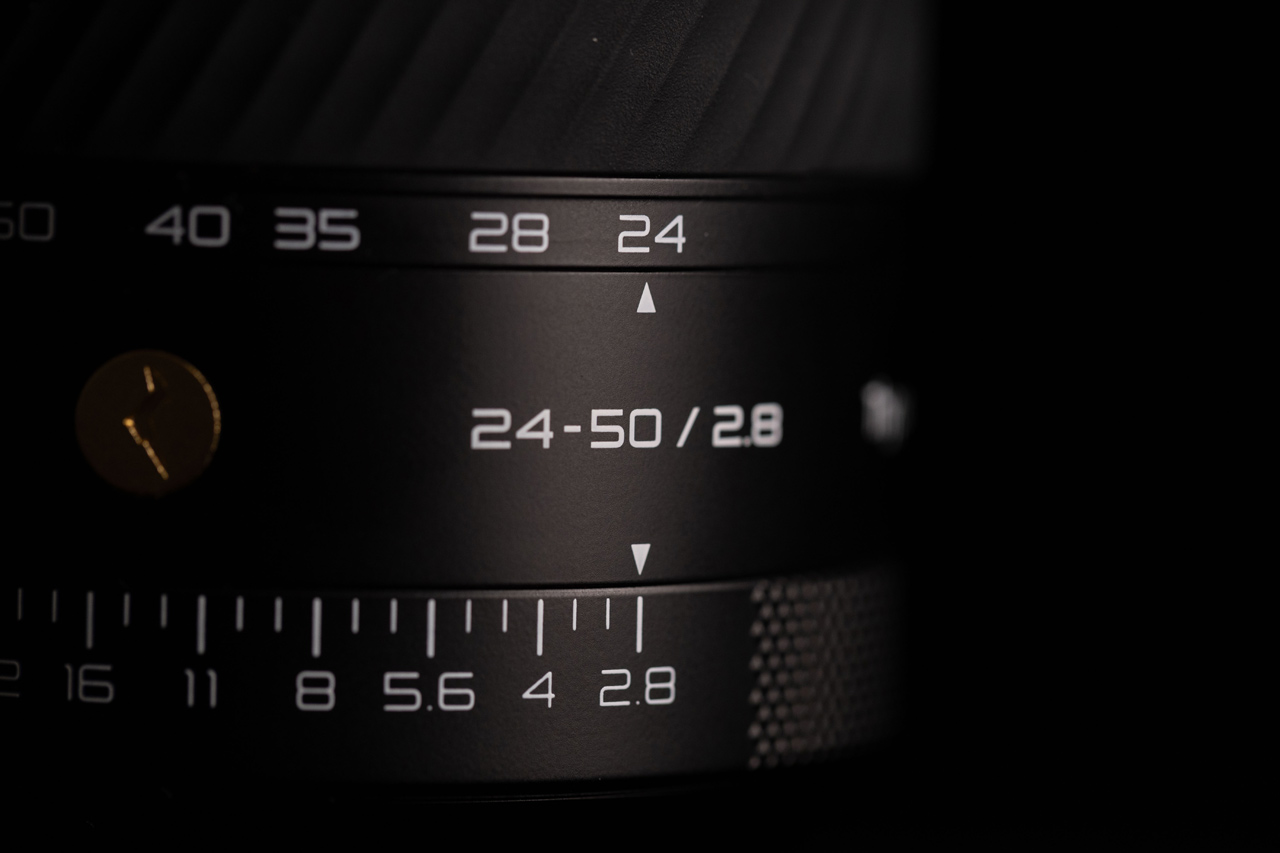
The 24-50mm range was chosen to strike a balance between size, design, and price. It covers the focal lengths that working photographers typically need on a daily basis. The Voyager features an inner zoom mechanism, maintaining an F2.8 aperture throughout the range while remaining compact enough to be attached to the camera all day long.
The Voyager is designed to deliver image quality comparable to dedicated prime lenses, whether at the expansive 24mm, the reportage-style 35mm, or the subject-isolation 50mm. The result is a lens that performs the functions of three prime lenses in the size and weight of a single lens.
Fixed overall length, constant aperture value
A fixed-length zoom lens that maintains an F2.8 aperture throughout its range eliminates two of the most common obstacles in fast-paced shooting: “rebalancing the gimbal every time you change the focal length” and “recalculating the exposure to match the change in aperture value.”
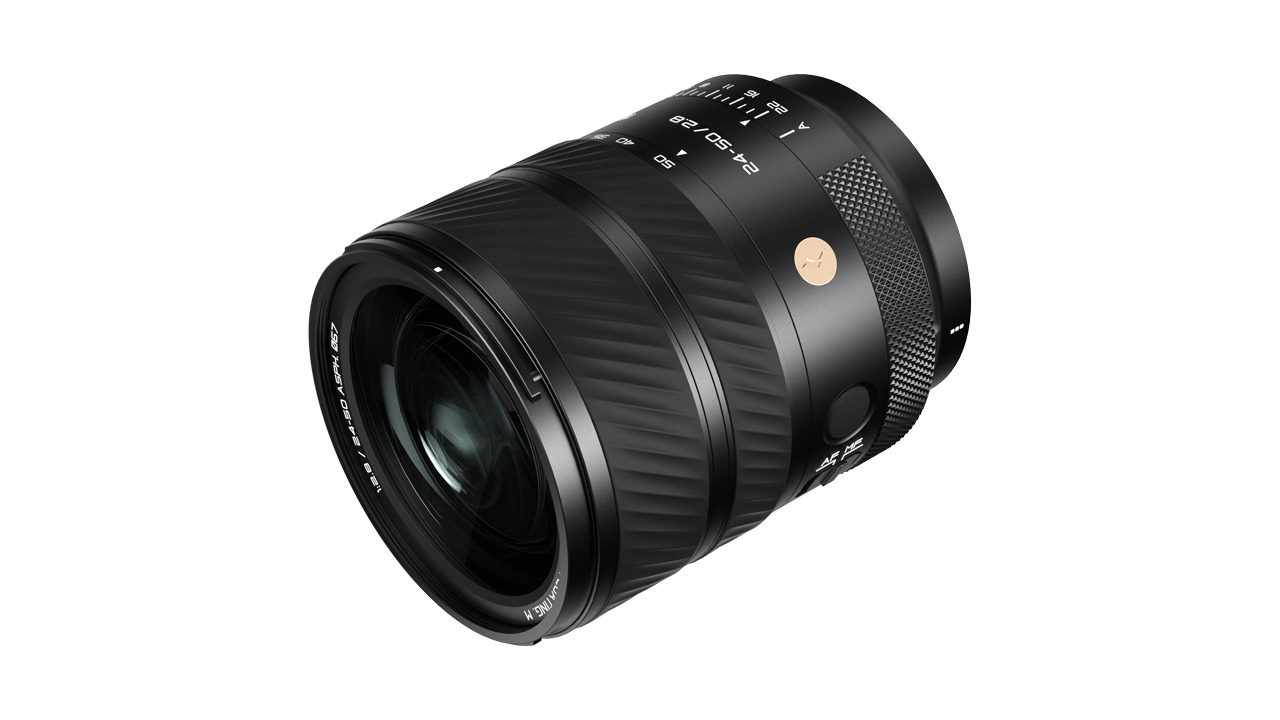
The Voyager’s internal zoom mechanism maintains a constant barrel length from 24mm to 50mm. The center of gravity does not shift during shooting. Furthermore, a fixed-length barrel is structurally more stable than a telescopic zoom lens, resulting in a more stable grip during handheld shooting.
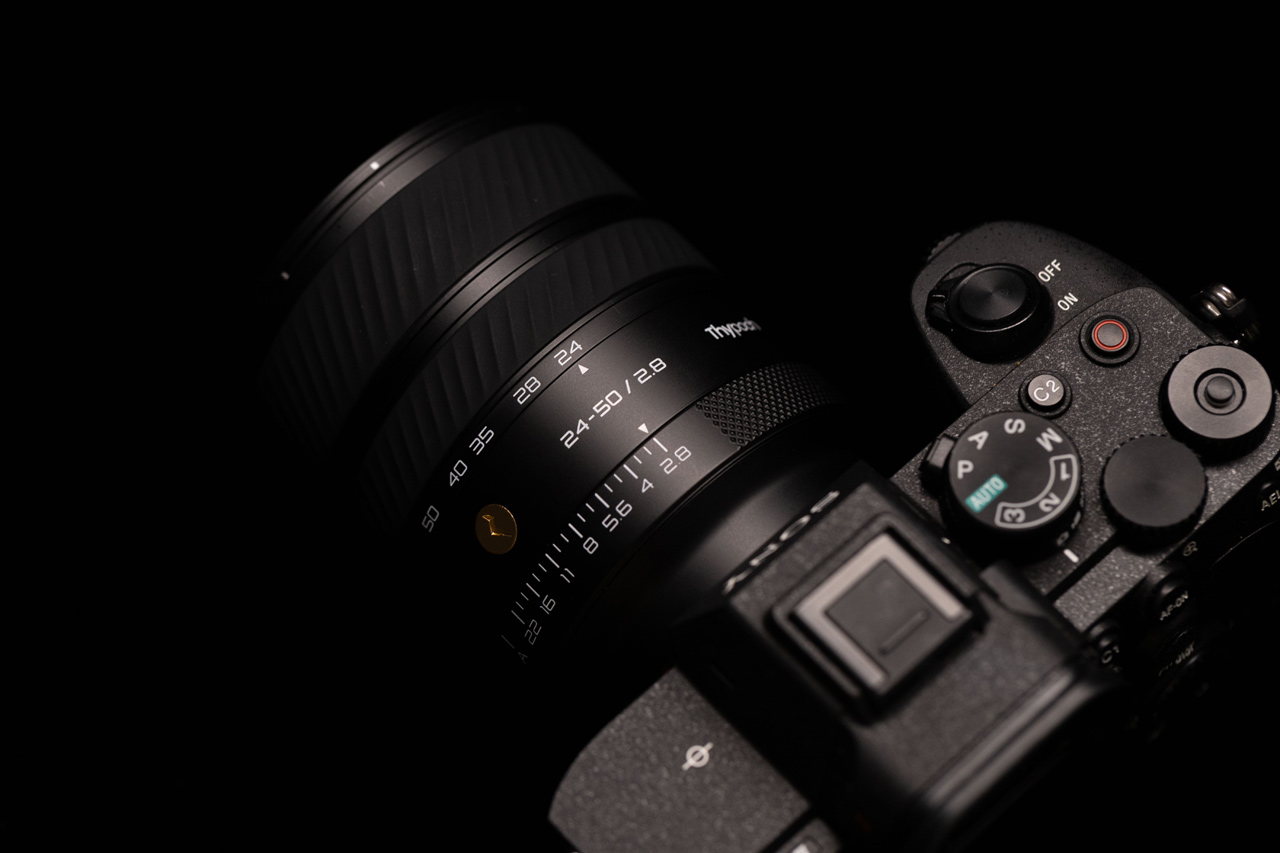
The bright f/2.8 aperture is maintained throughout the entire zoom range. From dimly lit interiors and twilight street corners to backlit portraits, f/2.8 provides the brightness and subject separation that photographers need in low-light conditions. Exposure remains consistent even when changing focal length, allowing you to concentrate on your shot without having to worry about the lens.
Furthermore, the fixed overall length eliminates the lens’s own weight-induced collapse (extension due to its own weight) when stored, and the external moving parts that complicated the dustproof and splashproof structure of conventional zoom lenses have been eliminated.
A first for China Optical Engineering.
The Voyager is the first full-frame AF zoom lens developed by a Chinese optical brand. Integrating autofocus, a full-frame image circle, and a zoom mechanism into a single lens requires advanced collaboration in the fields of optical design, precision engineering, AF systems, and electronics.
The Voyager’s AF system is designed for fast and quiet operation. Thypoch has built an AF unit that won’t interfere with your shooting. Its response speed is intended to match the pace of documentary, street, and event shooting, and its quiet operation is also suitable for video production and sound-sensitive environments. It is natively compatible with Sony E-mount and supports eye AF, AF-C tracking, and AF/MF switching on both the camera and lens.
This lens has been tested on current-generation Sony α bodies, including the ZV-E1, A7C2, A7CR, A7IV, A7V, A7RIV, A7RV, A7SIII, A9III, and FX3.
Design for bokeh
The character (individuality) of the image is the area in which Thypoch has built its reputation, and the Voyager inherits this priority even in its autofocus lenses. The optical design employs 16 elements in 13 groups, including two aspherical lenses (ASPH), three extra-low dispersion (ED) lenses, and three high refractive index (HRI) lenses. It is designed to control aberrations across all focal lengths and the entire image area.
The 10-blade circular aperture maintains its circular shape across the main aperture range, producing round out-of-focus highlights at medium apertures and beautiful sunstars at small apertures.

Not digital, but the power of optics.
The Thypoch Voyager 24-50mm out-of-focus rendering is not achieved through software processing, but rather through the glass itself. The optical bokeh behaves naturally at the edges of the screen, around specular highlights, and in transitional areas where digital bokeh tends to be flat. As a result, it creates a depth of field that can withstand full resolution and close examination of fine details.
The transition from the in-focus area to the background blur is gradual, resulting in a rendering that is not merely sharp, but possesses the unique character of a lens. The subject stands out with a strong presence, separated from the background without the unnatural, flattened look that can occur with such lenses.
Seal all joints
Dust and splash resistance is the deciding factor between a lens that works in the actual shooting environment of a photographer and one that needs protection. The Voyager employs a structure with sealing applied to the lens mount, focus ring, zoom ring, and front element. The inner zoom design contributes to improved sealing by eliminating the expansion and contraction of the outer barrel, which was the most common cause of water ingress in conventional zoom lenses.
This lens was developed with dust and splash resistance in mind. Whether in the fog of a coastal area or a sudden downpour in an urban area, the Voyager is built to continue operating. When combined with Sony’s own dust and splash-proof α body, it creates a completely sealed shooting system without creating any weaknesses in the shooting system.
The lineage of Cinema Zoom
The Voyager is Thypoch’s first autofocus lens. Its zoom structure is based on the parent company’s experience in cinema zoom lens engineering, which has enabled a constant aperture and inner zoom design across multiple cine lens families. Cinema zoom was the first field to solve the challenges of a constant aperture and a fixed barrel length. The Voyager applies this discipline to an autofocus lens for still format.
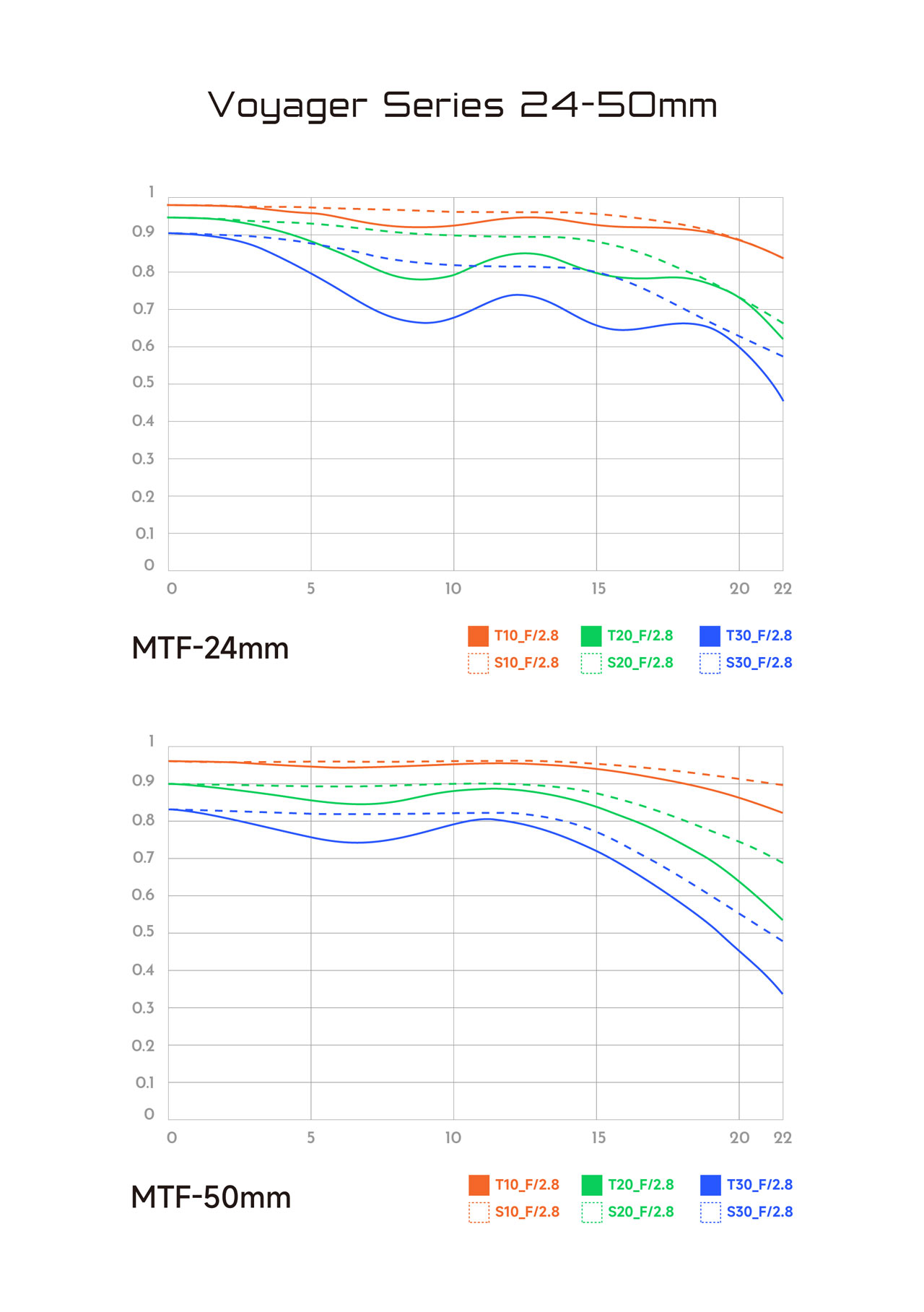
Thypoch Voyager 24-50mm f/2.8 Main specifications
| focal length | 24-50mm |
| Maximum aperture | F2.8 constant |
| optical configuration | 16 elements in 13 groups (2 aspherical, 3 ED, 3 HRI) |
| Aperture blades | 10 pieces (circular) |
| Minimum focusing distance | 0.3m across the entire zoom range |
| Maximum magnification | 0.216 times |
| filter diameter | φ67mm |
| weight | 432g |
| full length | 92.88mm |
| Maximum diameter | φ73.6mm |
| mount | Sony E |
| weather resistance | Designed with dust and water resistance in mind. |