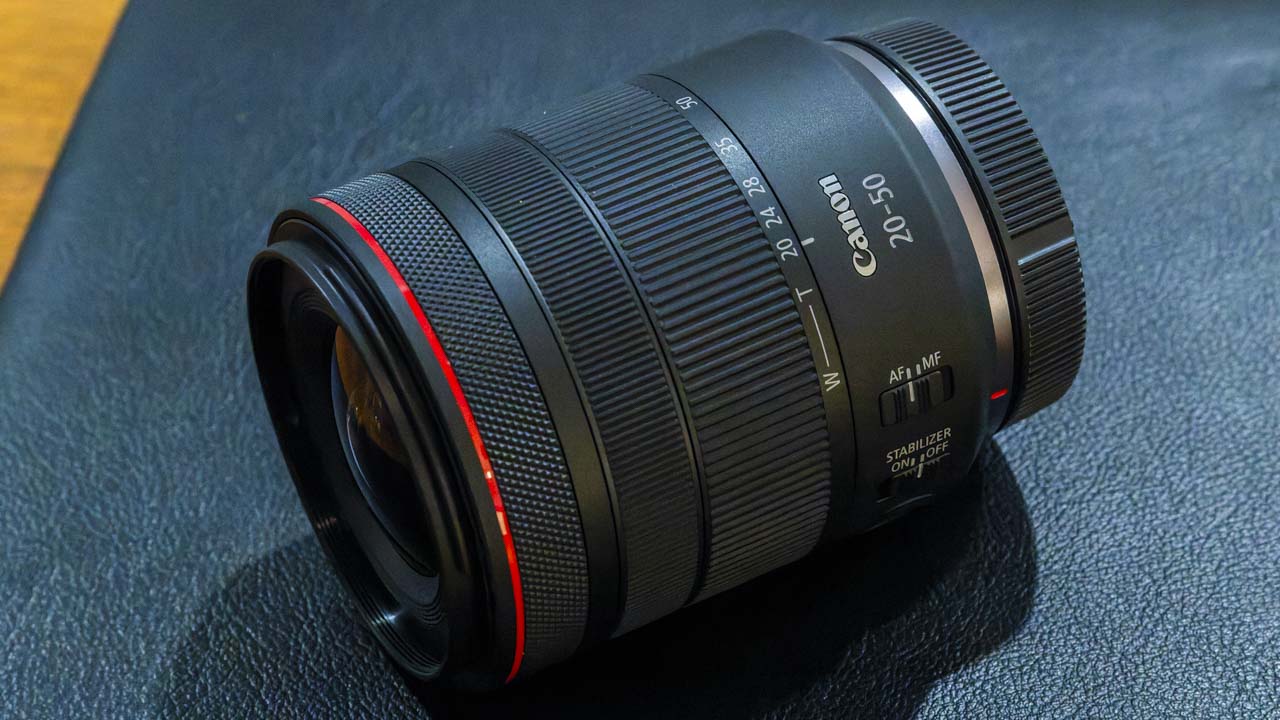
Canon will release the RF20-50mm F4 L IS USM PZ interchangeable lens for RF mount in mid-to-late June 2026. This lens is the first full-frame compatible RF lens to incorporate a power zoom mechanism and will also be offered as a kit lens for the EOS R6 V.
RF20-50mm F4 L IS USM PZ Specs
| focal length | 20-50mm |
|---|---|
| Open F number | F4 |
| Minimum focusing distance | 0.24m |
| Maximum magnification | 0.14x (at 20mm), 0.33x (at 50mm) |
| Lens configuration | 13 elements in 11 groups |
| Special lenses | Two GMo aspheric lenses, three UD lenses |
| filter size | Φ67mm |
| Number of aperture blades | 9 sheets |
| IS (CIPA2024 standard) | Central 6.0 stages / Cooperative control: Central 8.0 stages, peripheral 8.0 stages |
| Focus drive system | Nano USM |
| length | Approximately 98.4mm |
| Maximum diameter | Approximately Φ79.9mm |
| mass | Approximately 420g |
20mm starting F4 L standard zoom
This is a standard zoom lens with a constant f/4 aperture, covering a focal length from 20mm to 50mm. Starting at 20mm, it allows for dynamic image expression that utilizes perspective at the wide-angle end, while also providing a natural standard field of view close to that of the human eye at 50mm. This configuration allows it to cover a wide range of scenes with just one lens.
At the 20mm end, it’s possible to capture a large background and emphasize perspective in your shots, making it ideal for vlogs, landscape photography, and video shooting that involves movement. On the other hand, at the 50mm end, it’s easy to handle portraits and everyday snapshots, allowing you to adapt to a wide range of shooting styles while minimizing the need to change lenses.
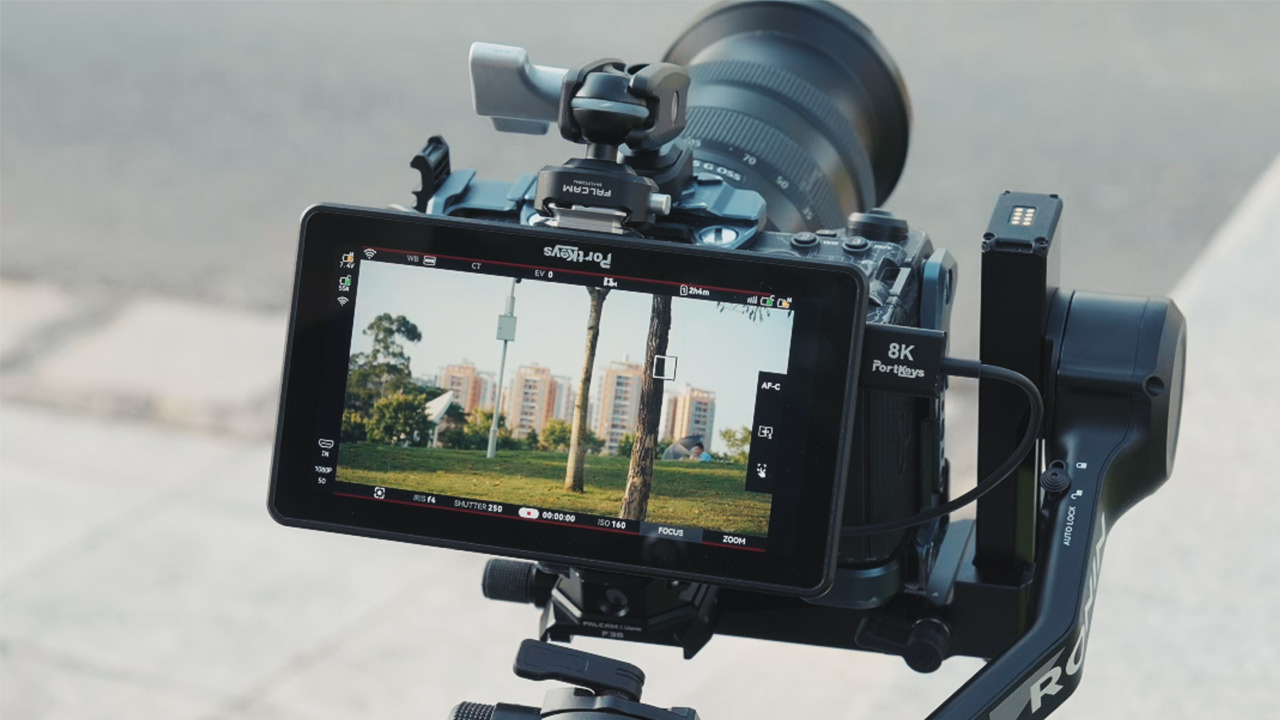
The main unit weighs approximately 420g. The lens barrel employs a fixed-length design where the front element does not extend, making it easier to minimize balance changes even when using a gimbal. Designed with consideration for reducing strain during long handheld shooting sessions, its compact body makes it easy to integrate into rigs and various other shooting equipment.
Furthermore, this lens is compatible not only with the EOS R6 V but also with other EOS series and CINEMA EOS series cameras, making it suitable for use in a variety of production environments.
With a focus on optical performance, this lens was designed to achieve image quality equal to or better than the RF24-105mm F4 L IS USM. The use of two aspherical lenses achieves both a compact and lightweight design and high image quality across the entire frame. Furthermore, the effective placement of three UD lenses corrects chromatic aberration across the entire zoom range, resulting in clear image quality with reduced color fringing.
The coating uses ASC (Air Sphere Coating). Compared to conventional vapor-deposited film coatings, it has a higher anti-reflective effect and reduces flare and ghosting that tend to occur in backlit environments.
Close-up shooting performance has also been enhanced. The minimum focusing distance is 0.24m, and the maximum magnification is 0.33x (at 50mm). At the wide-angle 20mm end, close-up shooting with emphasized perspective is possible, allowing for dynamic image expression with a large background. On the other hand, at the 50mm end, it is possible to shoot close-ups of subjects, such as table photography and shooting small objects, while maintaining a natural perspective.
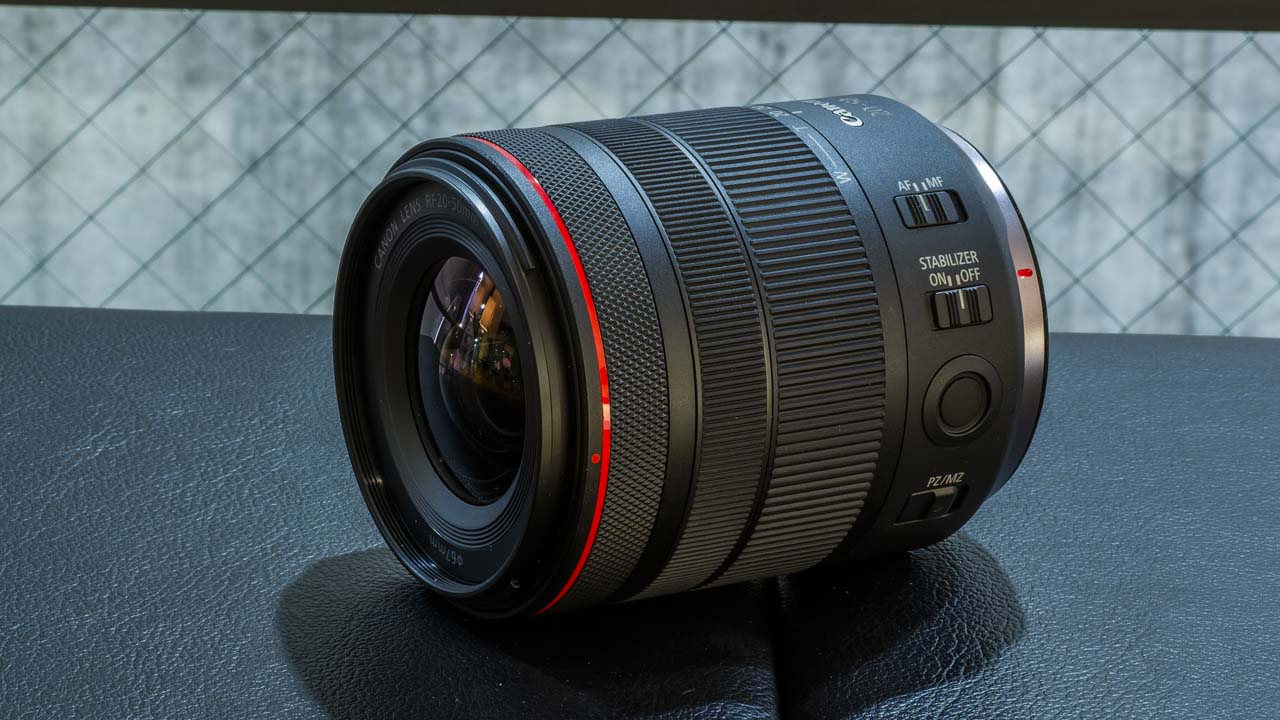
First full-frame compatible RF lens with built-in power zoom
The most distinctive feature of this lens is the inclusion of a power zoom mechanism, a first for full-frame RF lenses. When shooting video, the smooth zoom operation makes it easier to create natural-looking footage, and it supports zoom control according to your shooting intentions, from fast zooming to slow zooming.
The zoom speed can be selected from two levels: [Fast/Slow], and further, 15 fine-tuned speed settings are available for both the slow and fast sides. The [Fast] setting is convenient for quick composition checks when waiting to shoot or taking still images, while the [Slow] setting is convenient for smooth video production when recording video.
Furthermore, it supports a two-stage zoom operation where the speed changes depending on the amount the zoom lever is moved. Small movements result in slow zoom, while larger movements result in fast zoom, enabling intuitive operation according to the shooting scene.
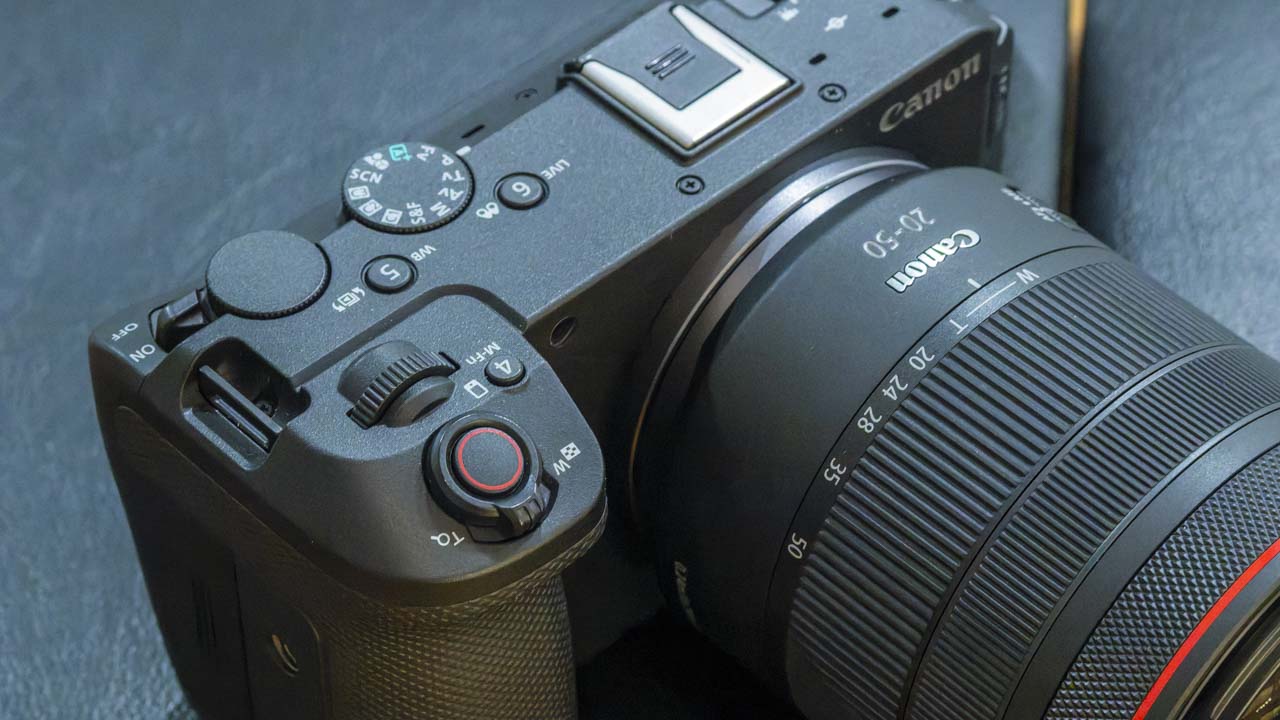
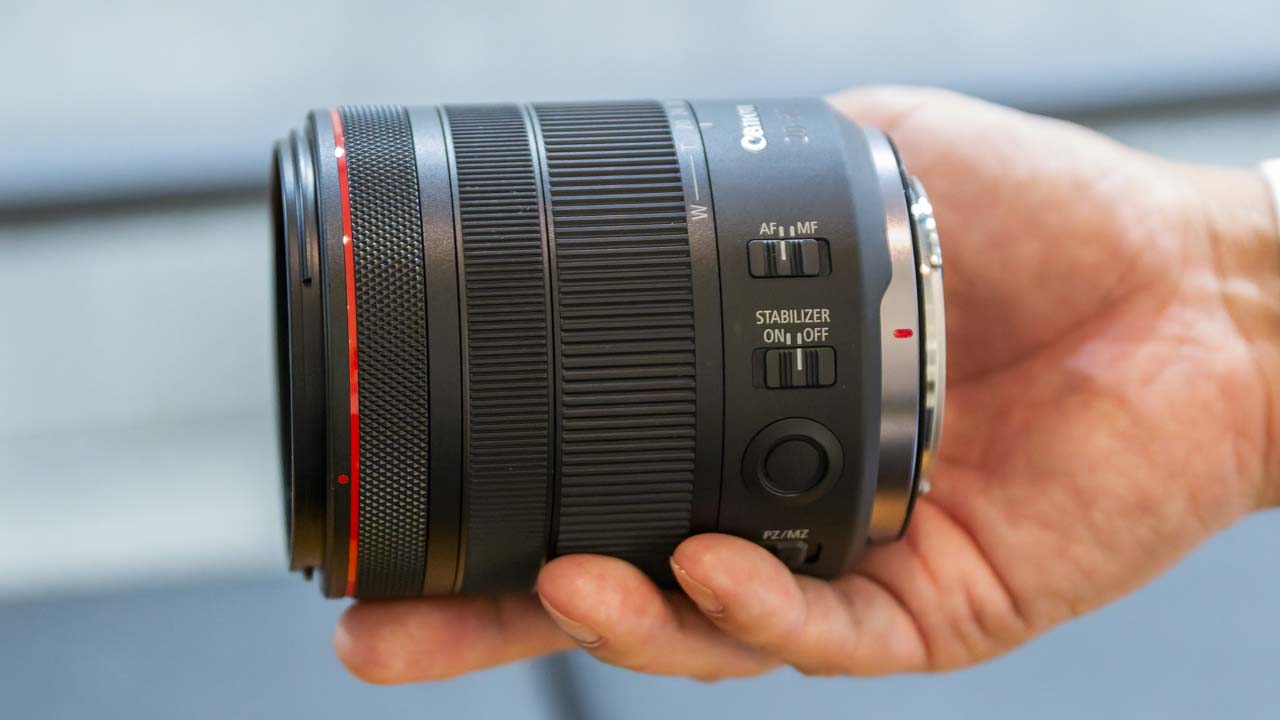
The controls also incorporate clever design features. A zoom mode switch is located on the side of the lens, allowing users to switch between manual zoom and power zoom. By integrating the controls into a single zoom ring, users can directly operate the manual zoom when taking still images, while utilizing the smooth power zoom when shooting videos.
Furthermore, in addition to the zoom ring on the lens, power zoom can also be operated via the zoom lever or custom buttons on the compatible camera. On compatible cameras such as the EOS R6 V, power zoom can also be operated using the zoom lever on the camera body.
On the other hand, when using manual zoom, the lens features a focal length display and a mechanical end, providing an operating feel similar to that of a typical zoom lens without power zoom. This configuration is designed not only for video use but also for intuitive operation when shooting still images.

Enjoy comfortable shooting of both videos and still images.
In terms of AF performance, it is equipped with a total of three high-performance nano USM units: two for zoom and one for focusing. By electronically controlling the positions of the three optical units, it achieves high-speed and high-precision AF tracking performance while stably maintaining the focus position.
By combining a rear-focusing system with nano USM drive, the camera enables fast and accurate autofocus operation during still image shooting. Furthermore, by optimizing the coordination between the actuator control by the microprocessor and the camera’s AF algorithm, smooth focus movement with reduced drive noise is possible during video recording.
RF20-50mm F4 L IS USM PZ Image Stability
The image stabilization function utilizes in-lens optical IS to achieve a 6.0-stop correction effect according to the CIPA 2024 standard. This allows for blur-free shooting even in low-light conditions or indoors where shutter speeds tend to decrease, enabling handheld shooting with reduced blur.
Furthermore, when mounted on an EOS R series camera equipped with in-body IS, it supports coordinated control with the lens-side IS, providing an 8-stop image stabilization effect in the center and an 8-stop effect around the edges. In addition, when combined with a camera equipped with video electronic IS, coordinated control of three systems—lens-side IS, in-body IS, and video electronic IS—is also possible.
Focus breathing, a common problem during video recording, is optically suppressed by the lens. By reducing changes in the angle of view due to focus shifts, it enables video recording with a stable composition.
Therefore, even when combined with a camera body that does not have an electronic focus breathing correction function, it is designed to easily produce images that maintain natural focus movement.