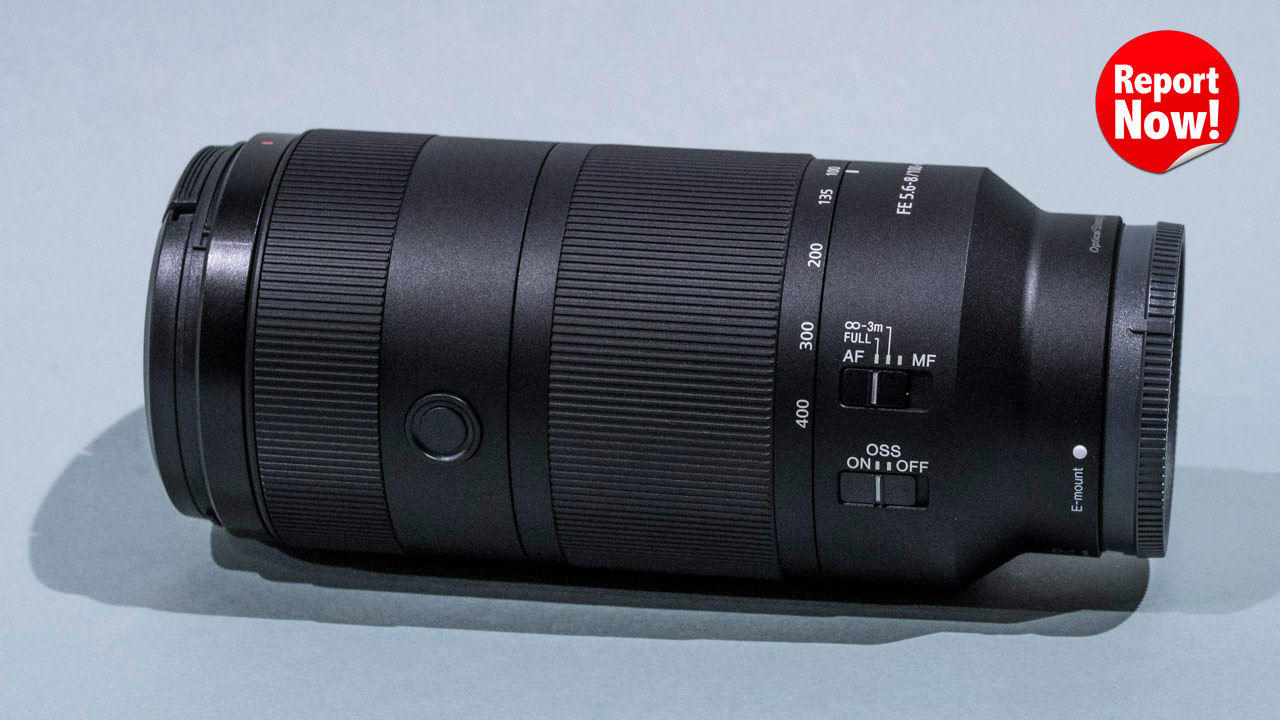
Sony announced the upcoming release of the “FE 100-400mm F5.6-8 OSS (SEL100400)” super-telephoto zoom lens for E-mount cameras compatible with 35mm full-frame sensors.
This new model covers focal lengths from 100mm to 400mm while achieving a compact and lightweight design with a maximum diameter of 78.2mm, a length of 164.5mm, and a weight of approximately 654g. Pre-orders will begin on August 18, 2026 at 10:00 AM, and the release is scheduled for September 4th.
New Addition to the Standard Line of Lenses
This product is not a G lens or G Master, but a standard-class super-telephoto zoom lens. By adding a compact, lightweight, and cost-effective 100-400mm lens to the lineup, it is positioned as an accessible option for users who want to start super-telephoto photography.
Looking solely at the price, it gives the strong impression of being an entry-level model. However, its features, such as support for a 2x teleconverter, close-up performance with a maximum magnification of 0.41x, in-lens image stabilization, and support for continuous shooting with AF/AE tracking at up to approximately 30 frames per second on the α7 V and up to approximately 120 frames per second on the α9 III, mean that it is far more than just a cheap version.
Rather than trying to pack in everything you’d expect from a super-telephoto lens at the highest level, this model prioritizes a balance of portability, price, image quality, autofocus, and operability.
What is the Sony FE 100-400mm F5.6-8 OSS ?
A new entry-level model joins Sony’s super-telephoto lineup.
Up until now, Sony’s super-telephoto zoom lenses have included the “FE 100-400mm F4.5-5.6 GM OSS,” “FE 200-600mm F5.6-6.3 G OSS,” and “FE 400-800mm F6.3-8 G OSS.”


*Click image to enlarge

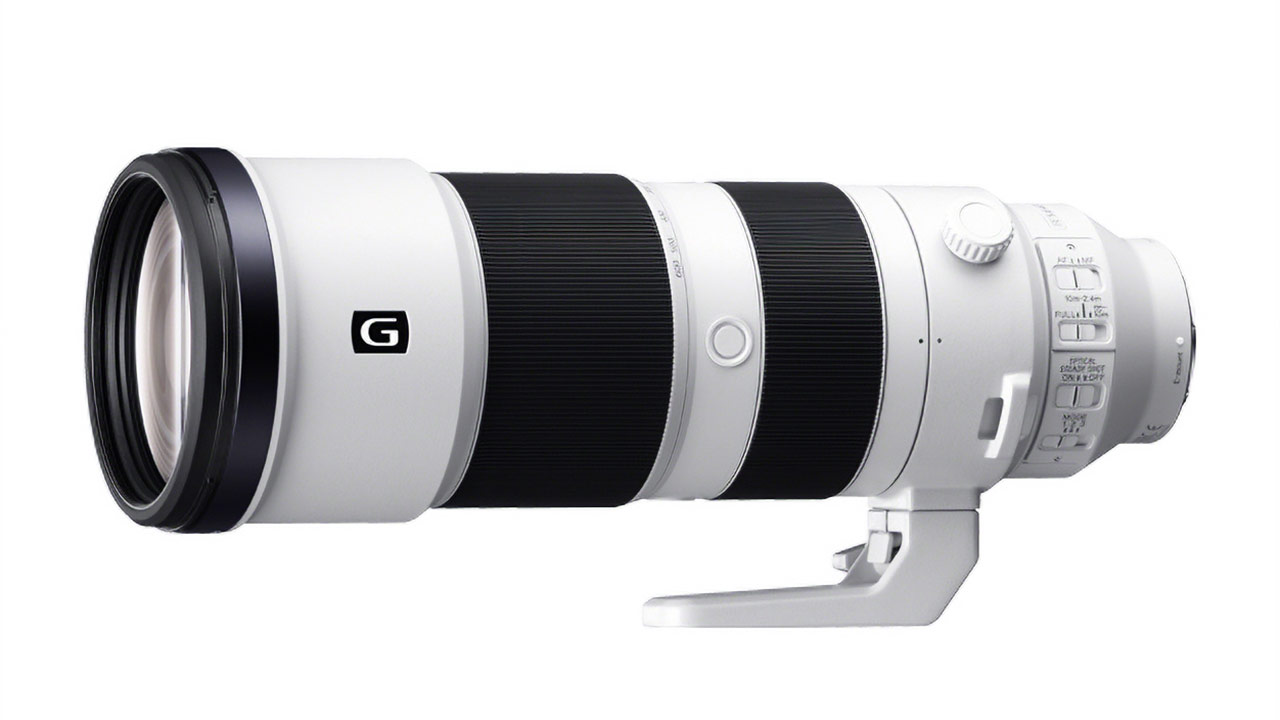
Previous Super-telephoto Lenses are Expensive
While all of these lenses are capable of serious super-telephoto photography, they are mainly priced between 300,000 and 400,000 Japanese yen, and weigh well over 1 kg. For users who want to start photographing wild birds, trains, sports, etc., the price and size have made them difficult to adopt. The new FE 100-400mm F5.6-8 OSS will be positioned in a clearly different location from previous products, with an estimated market price near $1,000.
Sony envisions a gradual progression, starting with this product for super-telephoto photography, then moving on to the 200-600mm or 400-800mm lenses as longer focal lengths are needed, and finally transitioning to the G Master series for higher resolution and advanced features. This product is designed to make super-telephoto lenses more accessible as an addition to a standard zoom lens, rather than being seen as highly specialized equipment.
Compact and lightweight design, lens weighs 654g.
The FE 100-400mm F5.6-8 OSS has a maximum diameter of 78.2mm, a total length of 164.5mm, and weighs approximately 654g. The filter diameter is 67mm. The conventional “FE 100-400mm F4.5-5.6 GM OSS” weighs 1395g, has a maximum diameter of 93.9mm, and a total length of 205mm. This product covers the same 100-400mm range while reducing its weight to less than half.
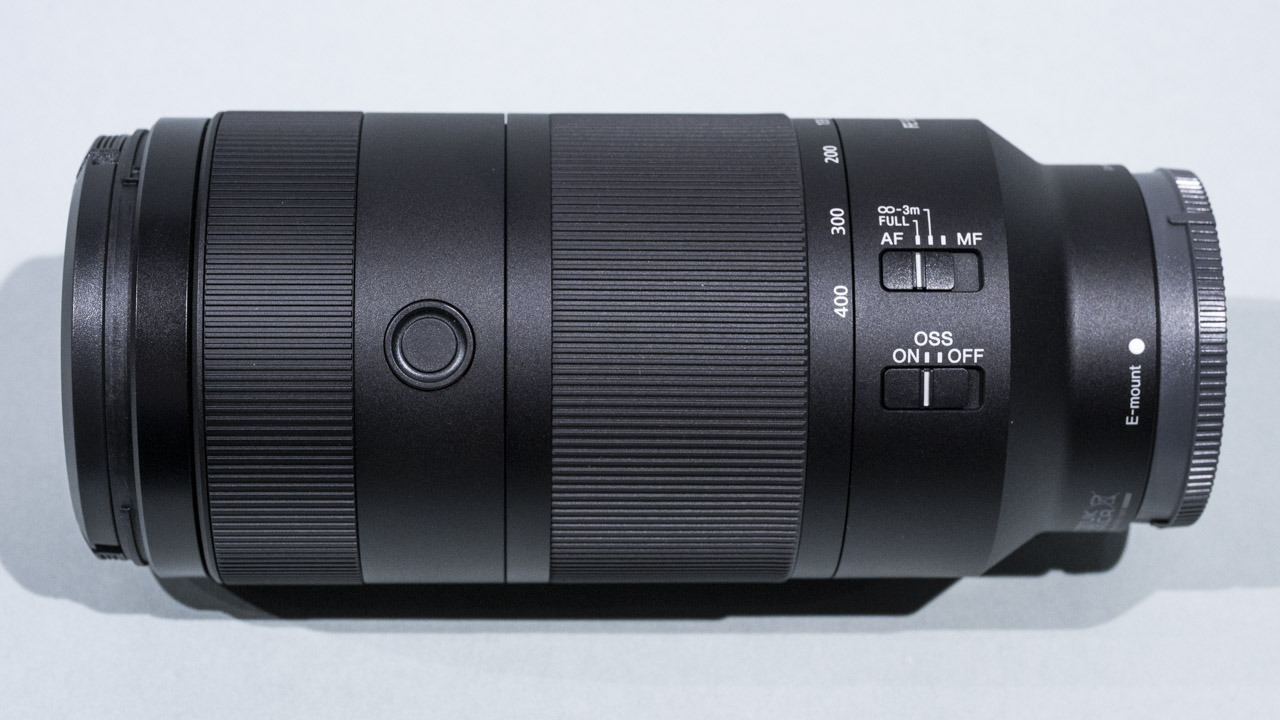
Of course, these products cannot be simply compared based on weight alone, as they differ in terms of maximum aperture, optical performance, AF drive, and control system. Nevertheless, the fact that a full-frame compatible zoom lens capable of shooting up to 400mm weighs approximately 654g is a significant advantage. When photographing wild birds or trains, you often search for subjects while walking to your destination. Since you spend a long time carrying the lens not only while using it but also while traveling, lightness affects not only comfort during shooting but also how often you take it out.
This lens is built for mobility.
Even the highest-performing super-telephoto lenses are useless for photography if they’re too heavy to carry around and you end up leaving them at home. In that sense, the weight of approximately 654g represents the product’s character more than just its specifications. It works not only with full-frame cameras, but also with APS-C cameras, providing a field of view equivalent to 150-600mm in 35mm format. Combining it with a lightweight APS-C body allows for the creation of an even more compact super-telephoto shooting system.
Covers a range from 100mm to 400mm with a single lens.
At the wide end of 100mm, it’s easy to compose shots while incorporating the surrounding environment, and at the telephoto end of 400mm, you can zoom in on wild birds, animals, people, and other subjects. The ability to use a single lens continuously from the 100mm end, where it’s easy to find subjects, to the 400mm end, where you can get close to expressions and details, is what makes this product so easy to use.
Example Portrait Shot on Sony FE 100-400mm F5.6-8 OSS
This example portrait was taken using an α7 V at 400mm, F8, 1/200 sec, and ISO 800. The hair, eyebrows, and eyelashes are rendered in detail, while the green background is smoothly blurred. The surrounding scenery is reflected in the eyes, demonstrating that even at the telephoto end, details are captured clearly. Although the maximum aperture is F8, the 400mm focal length and the distance from the subject to the background allow for a large background blur that makes the portrait stand out.

*Click image to enlarge
With a teleconverter attached, the maximum focal length is 800mm, and with an APS-C sensor, it’s equivalent to a maximum of 1200mm.
This product is compatible with 1.4x and 2x teleconverters. When the 2x teleconverter is attached, the maximum focal length is 800mm. When used with an APS-C camera or APS-C crop, the field of view can be extended to the equivalent of 1200mm in 35mm format. The Sony FE 100-400mm F5.6-8 OSS is typically used as a highly portable 100-400mm lens, and a teleconverter can be added for situations requiring longer focal lengths, such as photographing wild birds or aircraft.
Birding with the Sony FE 100-400mm F5.6-8 OSS and a Teleconverter
In the 800mm example, a 2x teleconverter was attached to photograph an owl perched on a tree. The shooting settings were 1/50 second, F16, ISO 3200, and the camera used was an α7 V.
The owl in the center is made to stand out by using the surrounding leaves as foreground and background blur. The 800mm focal length not only makes the subject appear large, but also compresses the foreground and background scenery, creating a sense of depth that differs from what the naked eye sees.

*Click image to enlarge
However, when using a 2x teleconverter, the maximum aperture becomes two stops darker. At the telephoto end, it becomes F16, so when shooting birds in flight or sports, which require fast shutter speeds, you need to consider the balance between light and ISO sensitivity. Rather than using 800mm as your everyday focal length, this product is better suited to being used as a lightweight 100-400mm zoom lens for everyday shooting, and extending the focal length only when necessary.
Uses two ED glass elements and two aspherical lenses.
The lens configuration consists of 10 groups and 15 elements, including two ED glass elements and two aspherical lenses.
The company claims that the use of ED glass reduces chromatic aberration and aspherical lenses effectively suppresses various aberrations, resulting in clear and sharp image quality. The lenses also feature multi-coating.

Unlike the G Master series, which uses numerous special lenses to pursue the highest level of resolution, this camera does not have a configuration that achieves the highest level of resolution through such means. On the other hand, while keeping the price and weight down, it does have a well-designed optical system to correct chromatic aberration and distortion, which are often problematic with super-telephoto lenses.
Natural, soft bokeh thanks to a 9-blade circular aperture.
The aperture has 9 blades and employs a circular aperture. The published example of a squirrel was taken with an α7 V, 400mm, 1/160 sec, F8, ISO 2000. The squirrel’s fur, the area around its eyes, and its whiskers are rendered in detail, while the trees in the background and the leaves in the foreground are broadly and softly blurred.

*Click image to enlarge
With super-telephoto lenses, it’s common to blur the background significantly to isolate the subject. Therefore, not only is the resolution performance at the focal plane important, but how the image changes outside the focal point is also crucial.
This product has an open aperture of F5.6 at 100mm and F8 at 400mm. While the numbers may seem relatively dark, the long focal length allows for significant bokeh if you get close to the subject and maintain sufficient distance from the background.
Close-up shooting performance with a maximum magnification of 0.41x.
The maximum magnification is 0.41x. The minimum focusing distance is 1.13m at the wide end and 0.86m at the telephoto end. At the telephoto end of 400mm, you can take close-up shots while maintaining a certain distance from the subject. This is effective when photographing butterflies, insects, or wary small animals that fly away when you get too close.
While its maximum magnification of 0.41x doesn’t quite reach 1:1 macro, it offers excellent close-up capabilities for a super-telephoto zoom lens. Combining the compression effect of 400mm with background blur, it allows for a unique style of photography that makes the subject appear larger and more prominent, unlike typical macro lenses.
The same lens you take out to photograph wild birds or trains can also be used to photograph flowers and insects blooming in the area. This close-up capability will prove more useful than you might imagine when you’re out for a walk or traveling and want to minimize lens changes.
Fast Shooting on the Sony FE 100-400mm F5.6-8 OSS
The α7 V supports continuous shooting at up to approximately 30 frames per second, the α9 III supports continuous shooting at up to approximately 120 frames per second.
The AF drive system employs a double linear motor and a lightweight focusing lens. The two linear motors drive the focus group at high speed and with high precision, allowing it to quickly capture moving subjects and track them stably.
When paired with the α7 V, it supports continuous shooting with AF/AE tracking at up to approximately 30 frames per second, and when paired with the α9 III, it supports continuous shooting at up to approximately 120 frames per second. Continuous shooting at up to approximately 120 frames per second allows for continuous recording of movements that are difficult to accurately capture with just the photographer’s reaction, such as the moment a bird takes flight, just before it lands, or the moment a ball is hit. The lens’s ability to support this continuous shooting speed allows the high-speed performance of the α9 III to be fully utilized.
On the other hand, the α7 V also supports continuous shooting with AF/AE tracking at up to approximately 30 frames per second. The fact that high-speed continuous shooting is available not only on the top-of-the-line sports photography body but also on a wider range of user bodies makes this product well-suited to its target market.
Two Standard Linear Motors
While higher-end lenses employ an XD linear motor, this product uses two standard linear motors. Although this difference is likely due to cost-saving measures, it’s clearly designed for shooting moving subjects, rather than a simple AF configuration with a single motor.
Note that continuous shooting speed may decrease depending on shooting conditions. Also, continuous shooting speed may differ when the focus mode is set to AF-C.
Optical image stabilization that works in conjunction with the camera body.
The Sony FE 100-400mm F5.6-8 OSS features an optical image stabilization (OSS) mechanism. At 400mm, even slight camera movements can result in significant shake on the screen. Optical image stabilization reduces camera shake, making it easier to compose and frame shots when shooting handheld.
Furthermore, when paired with a compatible camera, it coordinates the control of both in-body image stabilization and optical image stabilization on the lens. This supports stable framing and comfortable shooting even with subjects at a distance.
In super-telephoto photography, it’s not just the blur at the moment the photo is taken that matters, but also whether you can keep tracking the subject in the viewfinder. If you can minimize screen shake, it becomes easier to track moving subjects like birds, trains, and athletes, and the burden of constantly adjusting the AF area to the subject is reduced.
However, the level of support for coordinated image stabilization varies depending on the camera. The effectiveness of image stabilization also varies depending on the camera used and the shooting conditions.
Easy-to-use controls, even for beginners.
The lens barrel features a focus ring, zoom ring, customizable focus hold button, image stabilization switch, focus mode/focus range switch, and zoom lock switch.


The focus hold button can be assigned any function via the camera’s settings. This allows for operations tailored to the photographer’s needs, such as subject recognition, eye AF, and focus area changes.
A distinctive feature is that the focus mode and focus range limit can be controlled with a single switch. It allows switching between using the entire focus range in AF mode, limiting the range to 3 meters from infinity, and switching to MF mode.
Focus Limiter for Birding or Railfanning
When photographing distant birds or trains, limiting the focus range from infinity to 3 meters helps prevent the autofocus from shifting too much to nearby grass or fences. Even if the subject is temporarily lost sight of, limiting the focus range allows for quicker recovery.
Instead of placing the AF/MF switch and focus range limiter separately, we integrated them into a single control system, aiming to keep the lens barrel compact while making it easy to understand even for first-time super-telephoto photographers.
Zoom Lock Function
The zoom lock switch prevents the lens barrel from extending unintentionally during transport. It is also easy to use when the camera is hanging from a strap or when taking it in and out of a camera bag.
The telescope tube employs a dustproof and splashproof design. Important joints and connections are sealed to effectively prevent the intrusion of dust and water droplets.
This lens is designed for use in harsh outdoor environments, such as when photographing wild birds in the morning dew or at sporting events where sand and dust are kicked up.
However, the dustproof and water-resistant performance does not completely prevent dust and water droplets from entering. In rainy weather or dusty environments, it is safer to use a rain cover or similar in conjunction with the product.
Super telephoto zoom lens that created value in a different way than the higher-end models.
The Sony FE 100-400mm F5.6-8 OSS is not simply a lower-priced version of the “G Master” 100-400mm. The higher-end model boasts a bright maximum aperture, exceptional optical performance, an XD linear motor, a comprehensive control system, and a fluorine coating on the front element, pushing the limits of shooting performance under harsh conditions.
In contrast, this product sets the maximum aperture to F5.6-8 and optimizes the AF motor and optics to achieve a lightweight design of approximately 654g and an affordable market price.
This isn’t simply a matter of superiority or inferiority, but rather a matter of the photographer’s choice of what they prioritize.
If you need to shoot in low-light conditions with fast shutter speeds, create significant background blur, or require top-tier resolution and AF tracking, a higher-end model would be ideal. However, if you primarily shoot outdoors during the day and want to use a 100-400mm lens with the lightest possible system, this product is more practical.
For super-telephoto lenses, mobility—the ability to carry them to the location—is just as important as image quality. In situations where it’s difficult to carry large lenses, such as travel, hiking, walks, or family events, the lightness of approximately 654g will be a powerful advantage in itself.
At 100mm, you can position your subject within a landscape, while at 400mm, you can capture people and small animals in detail. The focal length can be extended up to 800mm by using a teleconverter, and its close-up capabilities allow you to photograph flowers and insects.
The primary role of this product is to transform super-telephoto lenses from “equipment only used on special occasions” into a standard option that can be carried in a bag every day.
This lens will be an extremely attractive option not only for users attempting super-telephoto photography for the first time, but also for those who already own large lenses and are looking for a lightweight secondary lens for mobile shooting.
Sony FE 100-400mm F5.6-8 OSS Main Specifications
| item | FE 100-400mm F5.6-8 OSS |
| Model Name | SEL100400 |
| Compatible mounts | Sony E-mount |
| Compatible imaging screens | 35mm full frame |
| focal length | 100-400mm |
| 35mm equivalent when mounted on an APS-C sensor. | 150-600mm equivalent |
| Aperture | F5.6-8 |
| Lens configuration | 15 elements in 10 groups |
| ED glass | 2 sheets |
| Aspherical lenses | 2 sheets |
| Aperture blades | 9 blades, circular aperture |
| Maximum magnification | 0.41 times |
| Minimum focusing distance | 1.13m (wide end) / 0.86m (telephoto end) |
| filter diameter | 67mm |
| Maximum diameter x total length | 78.2 x 164.5 mm |
| mass | Approximately 654g |
| AF drive | Double linear motor |
| High-speed continuous shooting | The α7 V supports continuous shooting with AF/AE tracking at up to approximately 30 frames per second, and the α9 III supports continuous shooting at up to approximately 120 frames per second. |
| Image stabilization | Optical Image Stabilization (OSS) |
| Teleconverter | Supports 1.4x and 2x zoom. |
| When using a 2x teleconverter | Maximum 800mm |
| APS-C + 2x teleconverter | Equivalent to 35mm format maximum 1200mm |
| Dustproof and splashproof | Thoughtful design |
| Fluorine coating | Not included |
| Included hood | ALC-SH188, round type, bayonet mount. |
| price | Open price, estimated market price around 140,000 yen (tax included). |
| Order acceptance begins | Scheduled for August 18, 2026 at 10:00 AM |
| Release date | September 4, 2026 |