IBC 2026 / Booth Report
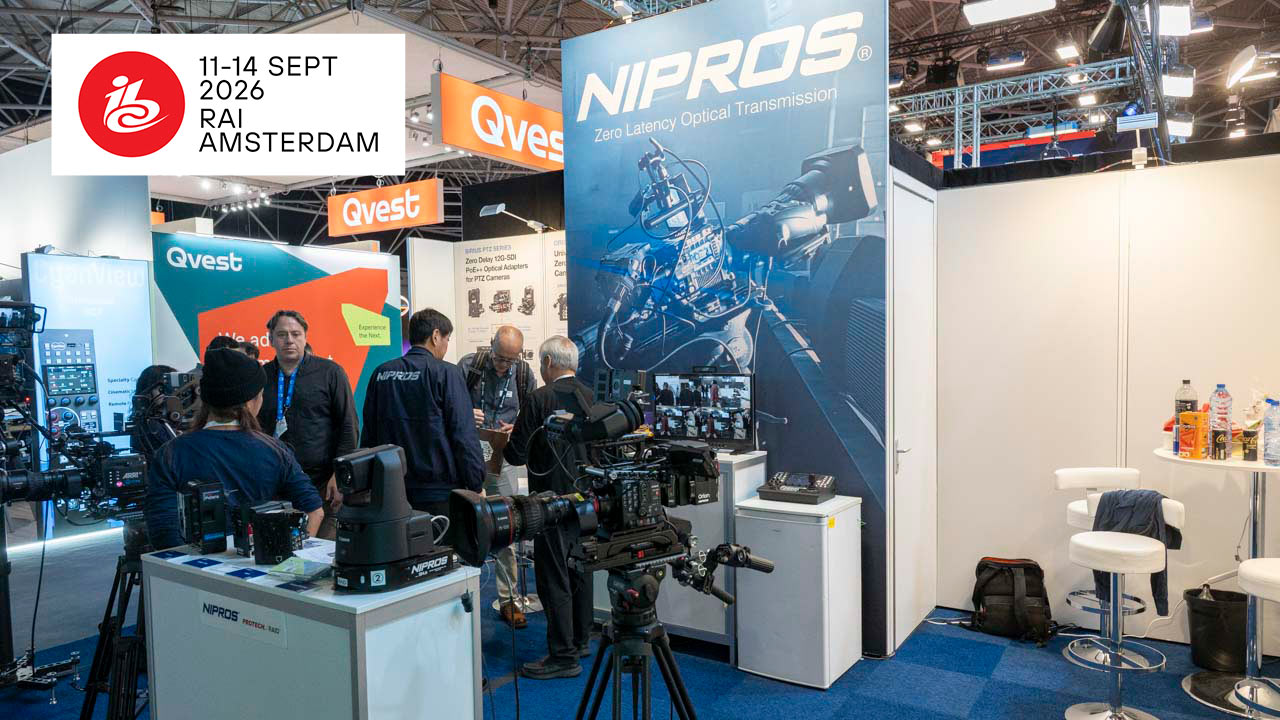
Our first target when visiting the NIPROS booth at IBC 2026 was the “Vega-R.” It’s a 4K SDI-compatible SMPTE optical transmission adapter designed for RED cameras, and it was a new product unveiled for the first time in the world at IBC 2026.
However, as we listened to the explanations at the booth and looked at the exhibits, it was evident that, not only the Vega-R, but also the Polaris, Orion, Orion Pro, and Vega series for cinema cameras, the SIRIUS PTZ series for PTZ cameras, and even viewfinders, were all moving in the same direction.
What they all have in common is the idea of integrating not only video, but also signals and functions needed on-site, such as power, control, return, tally, and intercom, into an optical transmission system, and incorporating various cameras into live production.
Vega-R and Orion expand possibilities of cinema live performance.
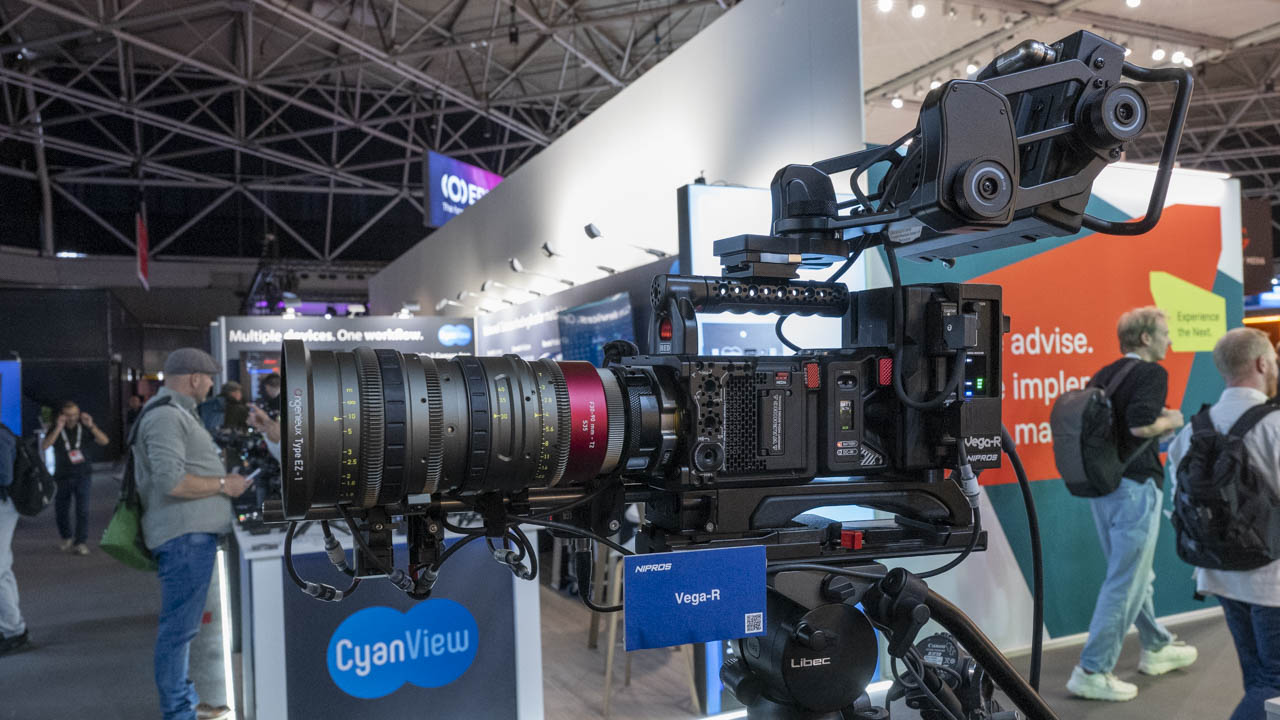
The Vega-R, unveiled for the first time globally at IBC 2026, is a compact optical transmission adapter designed with RED cameras in mind. It supports 4K video transmission via 12G-SDI. The design of this product aims to integrate RED cinema cameras into live production systems via SMPTE optical fiber.
Not Necessarily “RED-Exclusive”
What was interesting was that the Vega-R is positioned not so much as being “RED-exclusive,” but rather as a model that incorporates the functions and connectors required for RED. According to the NIPROS reps, it’s not that it can’t be used with other cameras, and it’s possible to develop Vega models that are tailored to the terminals and control methods required by each camera.
In recent years, the use of cinema cameras, including RED, in live production has increased. However, being able to output video from a camera is not the same as being able to operate it as a system camera for broadcast and live production. In actual practice, it is necessary to consider not only the video but also the return signal, tally, intercom, synchronization, camera and lens control, and power supply. This is precisely what Vega-R aims to address.
Orion Pro On Display Too
Around the Vega-R, Polaris, Orion Pro, and Vega were also on display as optical transmission adapters for cinema live production. All of these products are designed to integrate cinema cameras into live production, but their configurations differ depending on the required number of signals, camera control, and power supply scale.

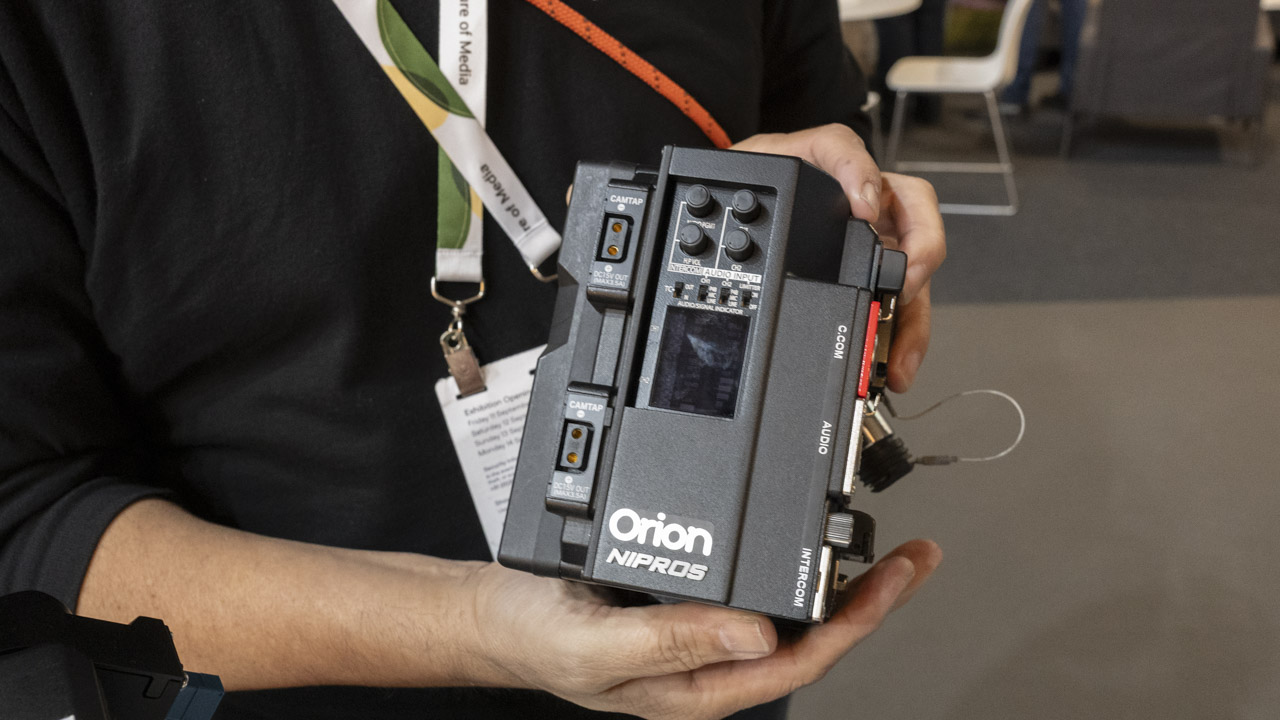
Orion Pro is a higher-end configuration that handles multiple 12G-SDI lines and supports return signals, teleprompter operation, camera/lens control, 1GbE, and more. Orion is positioned as a compact optical transmission system for 4K cinema live events, while Vega is a lighter configuration.
Let’s Have A Closer Look
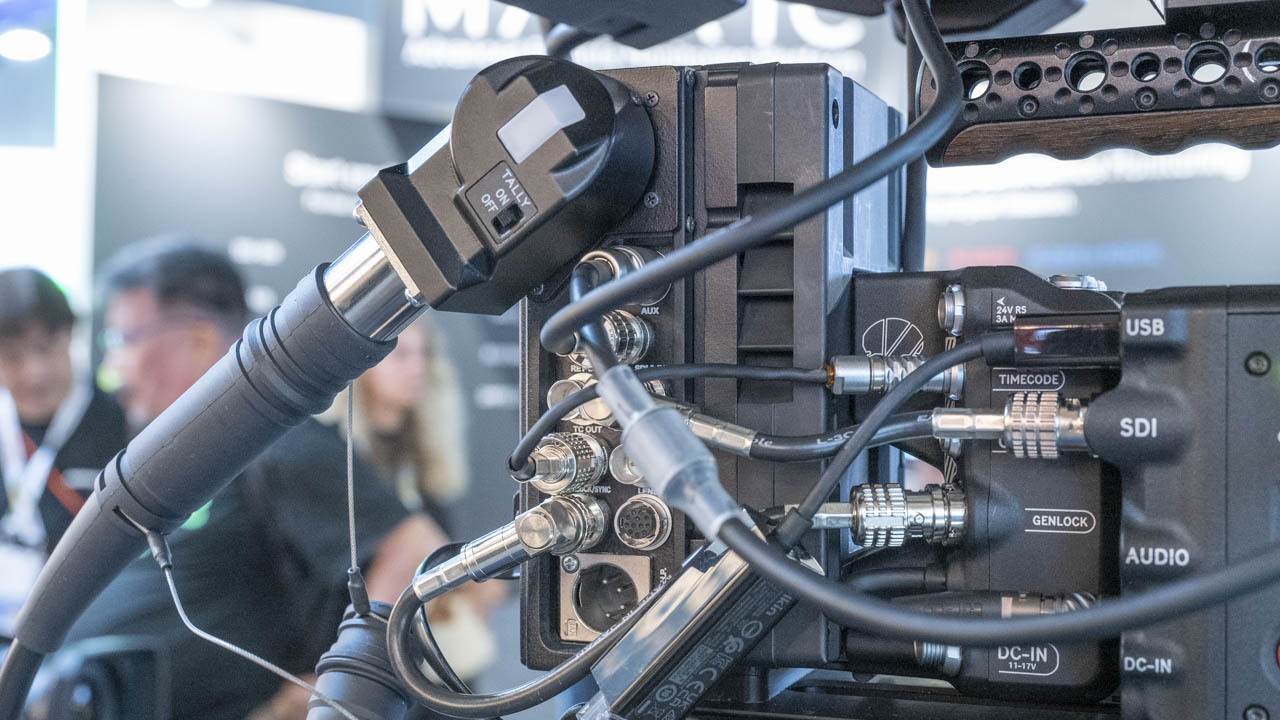
Looking at the documentation and the actual device, we see a variety of interfaces used in different camera systems, including a 12-pin lens connector, RS-232C/422, Sony 8-pin, LANC, and 1GbE. It’s not just a simple video transmission device; it’s designed with the intention of integrating the camera and lens control systems into a live production system.
In particular, the Orion Pro is designed for use with a combination of power supply for 24V cameras and DC output for accessories. Cinema cameras such as the ARRI ALEXA 35 and Sony VENICE 2 use numerous accessories in addition to the camera body, including wireless focus, monitors, and lens-related equipment, making power supply design just as important as video transmission.
Furthermore, according to the representative, Orion Pro is also envisioned to incorporate lens control systems such as ARRI Hi-5, WCU-4, and cmotion in a simpler configuration.
Previously, I had the impression that Orion was “an optical transmission device for bringing cinema cameras into broadcast systems.” However, seeing this exhibition, it’s clear that the lineup itself has become more specialized in response to the demands of CineLive production.
SIRIUS PTZ to be in three models. PTZ will also be part of the system camera.
Another thing that surprised our team was the “SIRIUS PTZ” series. While receiving an explanation at the booth, we couldn’t help but ask, “Are there three different types of SIRIUS alone?”
The lineup consists of three models: “SIRIUS PTZ,” “SIRIUS PTZ Pro,” and “SIRIUS PTZ Pro MAX.” Rather than simply having higher performance on the top models, the configuration allows users to choose the features they need depending on how fully they want to integrate the PTZ into a professional live production system.


SIRIUS PTZ Pro MAX vs PTZ Pro
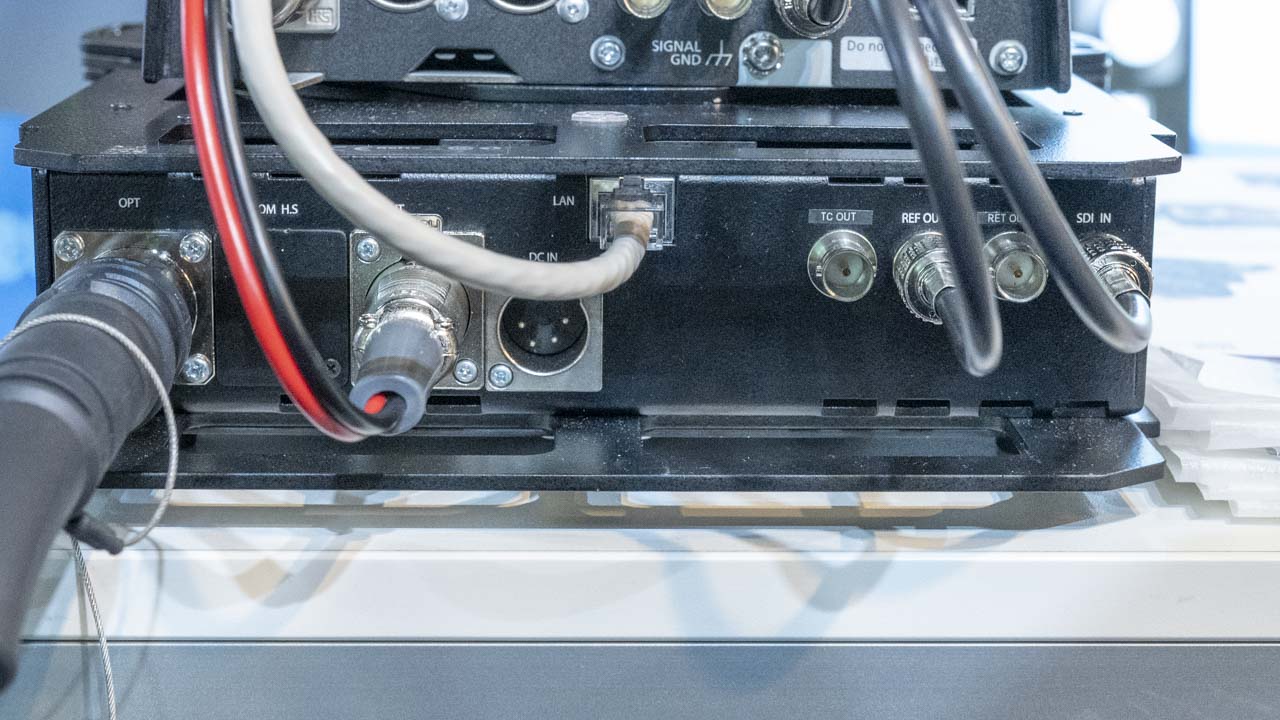
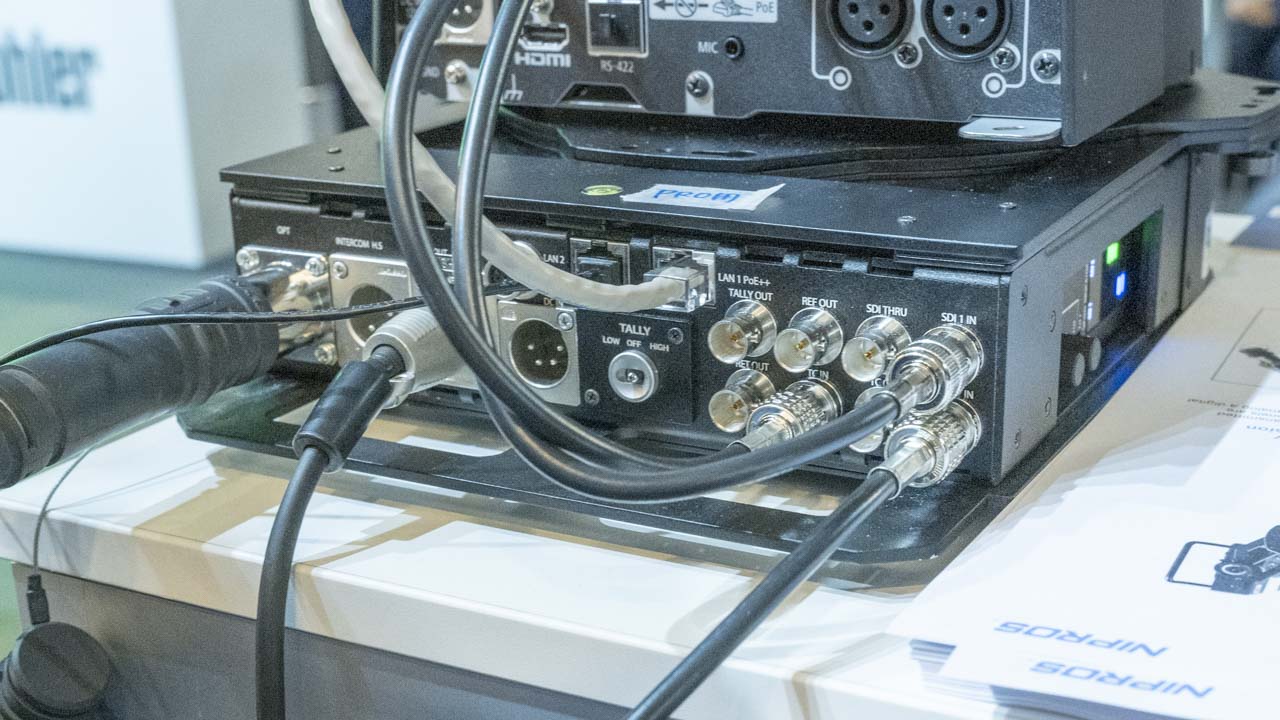
The top-of-the-line SIRIUS PTZ Pro MAX supports multiple 12G-SDI inputs/returns, two 1GbE lines, and PoE++ power supply. NIPROS documentation describes the Pro MAX as a “2-Camera Multi-Signal Throwdown Platform.” This means it’s not simply a device for extending a single PTZ camera via fiber optics, but rather a platform for handling two cameras and multiple signals together on-site.
The SIRIUS PTZ Pro streamlines its features while still offering essential functions for professional live operation, including 90W PoE++, SDI return, timecode, reference/synchronization, intercom, tally, and remote control. The SIRIUS PTZ, on the other hand, has a simpler configuration, allowing users to select the necessary functions depending on their application.
NIPROS explained that they were conducting tests with Sony FR7, as well as PTZ cameras from Panasonic and Canon. Furthermore, Pro MAX is designed to handle PTZ cameras and other cameras in the same system, and they showed an example of using it with a Canon EOS C400.
PTZ optical transmission itself is not unusual. However, NIPROS’s goal seemed to be more than simply extending video and network distances. Their aim was to integrate PTZ into existing broadcast and live production facilities, making it usable in a similar way to a standard system camera. That’s the purpose of their optical transmission system.
Viewfinder and “No Latency / No Conversion”
Furthermore, NIPROS viewfinders were also being showcased at their IBC2026 booth. When bringing cinema cameras into live production, it’s important not only to transmit the video, but also to create an environment where operators can operate them with a feel similar to that of conventional broadcast cameras.

When you consider everything from the viewfinder and return to the tally and lens control, it becomes clear that NIPROS is not aiming to be just a peripheral for the camera itself, but rather to create an environment where the camera can be treated as part of a live production system.


Asking the real questions at IBC2026 – Whats the NIRPOS Advantage?
Having seen the products up to this point, we asked the person in charge again, “What are the advantages of NIPROS’ optical transmission?” This is because various manufacturers were exhibiting camera transmission systems using optical fibers at the IBC venue, and optical transmission itself is not a technology unique to NIPROS.
The Orion/Vega documentation strongly emphasized the phrase “No Latency / No Conversion.” NIPROS’s philosophy is to treat each signal as an independent channel and transmit it while maintaining the original signal format as much as possible. It handles not only 12G-SDI but also various signals present on set, such as reference, timecode, LANC, tally, and serial communication.
The key features highlighted by the representative were lens control via 12-pin connection and compatibility with intercoms that allow direct connection of Clear-Com beltpacks. Furthermore, it features a mechanism that allows for handling RS-232C and RS-422 connections depending on the connected device, reducing the need for external converters.
What was even more interesting was the handshake during power supply. According to the person in charge, the system checks the connection status between the master unit and the slave unit before supplying power, and they hold patents for this method in Japan, the United States, and other countries. “For example, even if you drop the cable into water, if it’s not connected to the slave unit, it won’t supply high voltage,” they explained.
With the increasing adoption of IP technology, it might seem as though everything is being replaced by IP. However, in actual production environments, SDI, intercoms, tally signals, reference signals, serial control, and power supplies still exist. NIPROS’s optical transmission doesn’t force these into a single standard; instead, it focuses on aggregating the signals used on-site and transmitting them over long distances.
The NIPROS brand and the evolving role of optical transmission.
Another thing that left a strong impression at the IBC2026 exhibit was “NIPROS” and their brand itself. According to the person in charge, the company has been using NIPROS and PROTECH depending on the region. They have been using the PROTECH brand in Japan and the NIPROS brand overseas, but in recent years they have been moving towards putting the NIPROS brand more prominent.
To those who have followed PROTECH for many years, NIPROS might seem like a new brand. However, its products inherit the optical transmission technology that Nippon Video Systems has cultivated through PROTECH.
At the end of the interview, I asked about the current status of the optical transmission system. According to the person in charge, the number of units produced is expected to increase even further compared to the previous year.
The Future of PTZ, IP Systems, and Other Related Technologies
Live production using cinema cameras, labor-saving measures using PTZ, 4K resolution, and IP-based systems: as the range of camera options increases and production styles become more complex, the challenge of how to connect them to existing production systems becomes more apparent.
As cameras become more diverse, transmission devices are required to play the role of “integrating those cameras into a system camera.” Vega-R brings RED cameras into live production, Orion/Vega integrates cinema cameras into cinema-live environments, and SIRIUS PTZ integrates PTZ cameras into broadcast and live production systems. Although the target cameras differ, the underlying concept is the same.
By the time our team left the NIPROS booth at IBC2026, we had a clear understanding of the vast expansion of the field of optical transmission itself.
As cameras evolve, the transmission systems behind them also change. NIPROS’s exhibit demonstrated that optical transmission is no longer simply a “device for sending images,” but is transforming into infrastructure for integrating different types of cameras into a single production system.