Cine Gear 2026

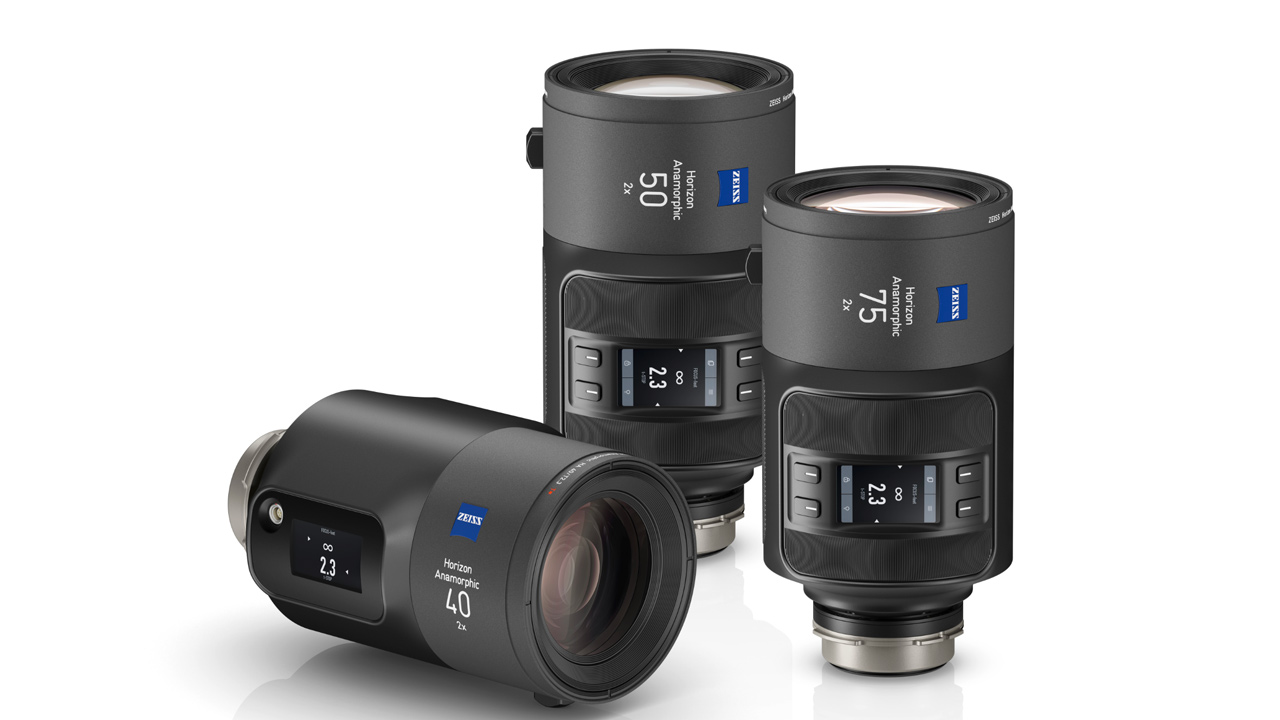
Our team visited the ZEISS booth at Cine Gear Expo LA to check out the details of the newly announced “Horizon Anamorphic” series of 2x anamorphic cinema lenses for full-frame sensors. The first impression was that, in a sense, it’s closer to a “network-enabled device” than a “lens.” This system integrates the focus and iris drive systems, communication functions, and look-changing functions into the lens itself, aiming to rethink the very concept of cinema lenses.
Evolution beyond mere optics: an “imaging platform”
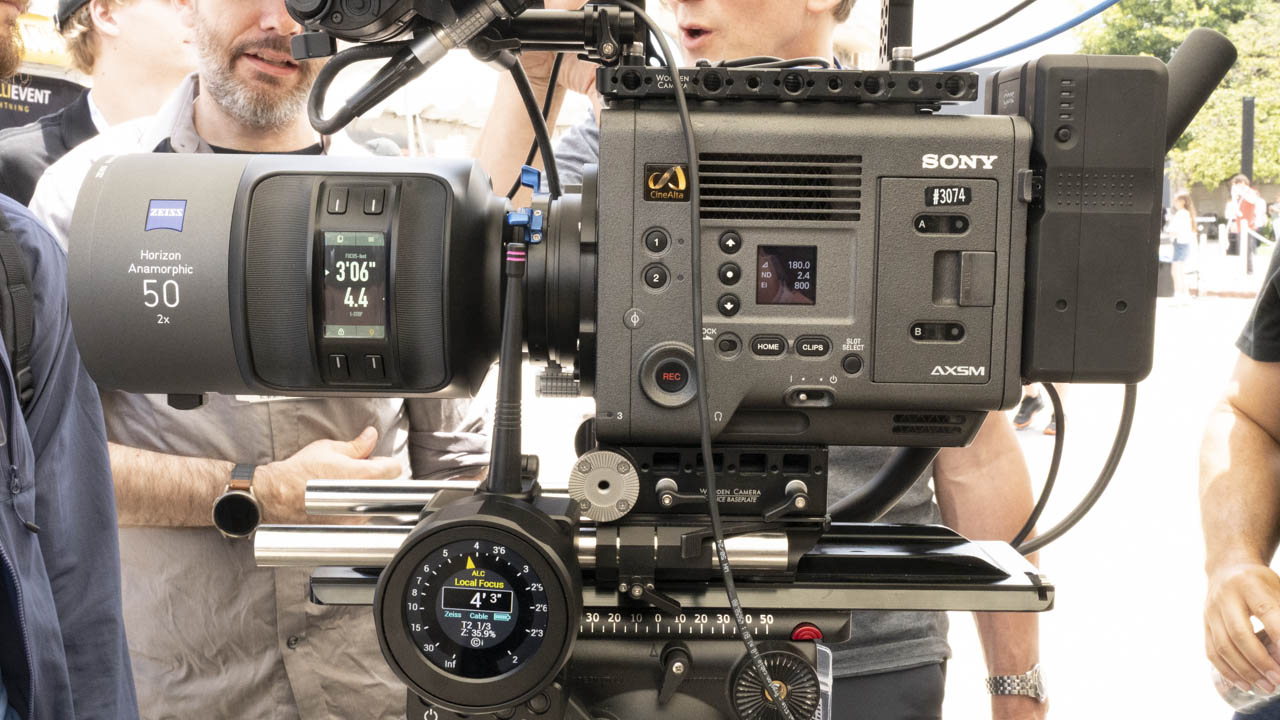
The most distinctive feature is that the focus and iris drive motors are completely housed inside the lens barrel. While conventional cinema lenses typically require external motors and gears, this system eliminates the need for them. When actually mounted on a camera, it results in an extremely clean and streamlined appearance.
ZEISS Horizon Anamorphic Operating System
A digital display is located on the side of the lens barrel, allowing direct confirmation of the focus position and iris value. Furthermore, two strip-shaped interfaces are positioned on top of the lens barrel; one controls the focus, and the other the iris. Since the values can be changed simply by tracing with a finger, intuitive operation is possible even during maintenance and inspection of the lens alone.
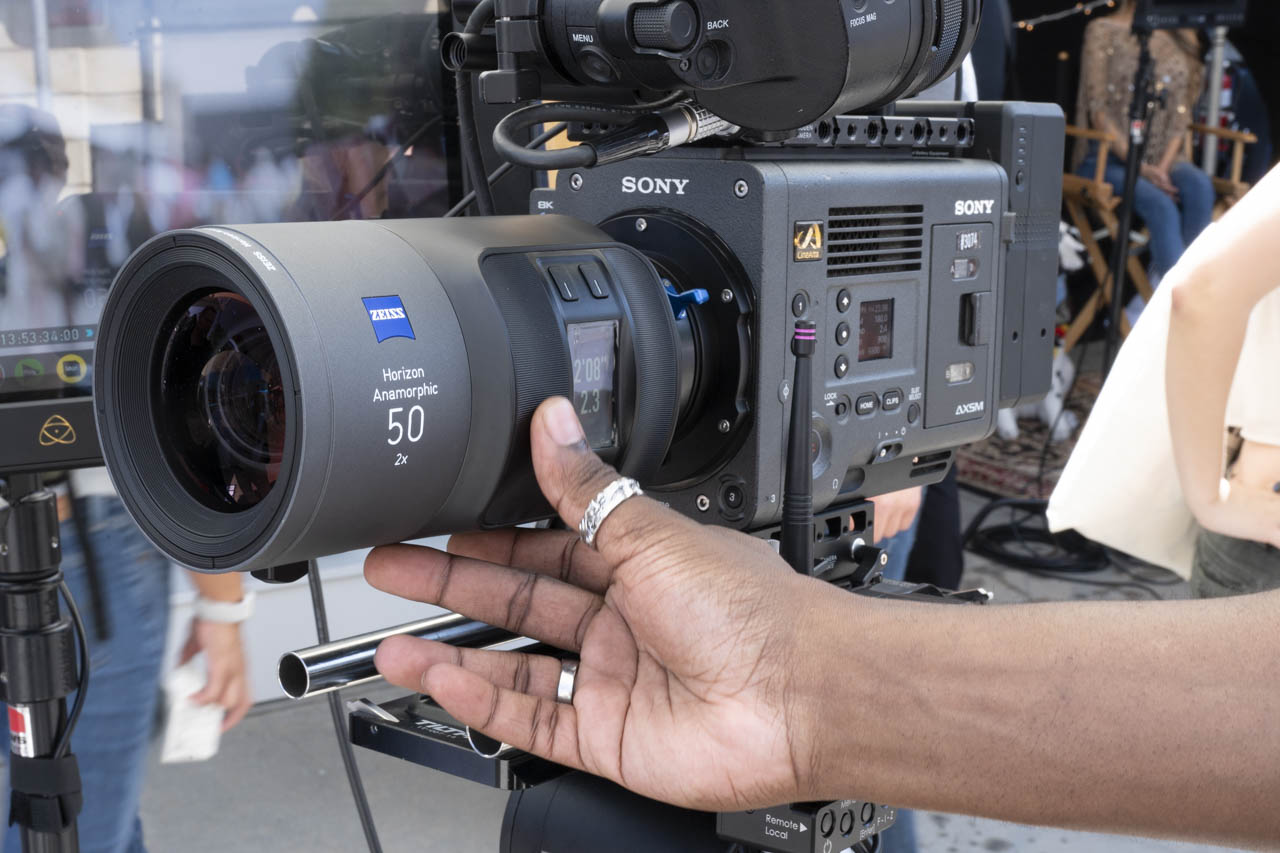

Our team actually tried out the focus operation. Moving from 2 feet to 5 feet was instantaneous, and the response was extremely quick. Despite using a fly-by-wire control system, we hardly noticed any delay. It was impressive that it would be perfectly usable even in the demanding world of cinema shooting where precise focusing is required.
The system is designed with integration with ARRI in mind, and integration with cmotion is planned for release. Power is supplied via the camera mount or MDR, and connection is simple. It is equipped with an absolute encoder internally, ensuring stable control while minimizing communication errors. Even when cameras are installed in places inaccessible to humans, such as cranes and jibs, the integrated control environment allows for flexible operation.

Particularly interesting was the maintenance design, which was thoroughly focused on on-site operation.
The design allows access to the internal module simply by removing a screw on the back of the telescope tube, enabling the replacement of electronic components and the motor itself. Because malfunctions can be addressed on a module-by-module basis, recovery time is significantly reduced. This reflects a development philosophy aimed at minimizing interruptions to shooting due to equipment problems.
Rear optics for look adjustment that changes the depiction itself.
Another notable feature of the ZEISS Horizon Anamorphic is the rear optics for adjusting the look.
This system uses an LPL mount instead of a PL mount. Choosing the LPL mount freed up internal space, allowing for the incorporation of not only electronic circuits but also a new optical system.
While the standard LPL mount has a hollow structure, this look-adjusting mount incorporates a dedicated optical element. Users can select different rendering characteristics simply by changing the mount. Even more distinctive is the communication between the mount and the lens body. The lens automatically recognizes the mounted look and adjusts the focus scale accordingly. This eliminates the need for the previously required offset adjustment, significantly reducing the workload of the camera assistant.
It is also well-suited to the recent trend towards larger sensors. The combination of a 3:2 sensor and 2x anamorphic scanning is an extremely rational configuration for current open-gate recording. It shows a design philosophy that optimizes for modern large sensors while maintaining the characteristic rendering properties of conventional 2x anamorphic scanning.
The direction ZEISS envisions for next-generation cinema lenses
ZEISS wasn’t exactly an early entrant into the anamorphic market. However, this late entry allowed them to incorporate numerous innovative ideas. These include a design that eliminates the need for an external motor, integrated communication functions, a modular maintenance structure, and a rear optic for adjusting the look and changing the image rendering. All of these are proposals aimed not merely at competing on lens performance, but at improving the overall efficiency of the shooting environment.
Gathered from this exhibition is that ZEISS is trying to redesign not just individual lenses, but the entire shooting system centered around the lens. This approach is very typical of ZEISS and has the potential to have a significant impact on the future of the cinema lens market.