Sony will release the first medium telephoto macro lens in the G Master series, the FE 100mm F2.8 Macro GM OSS, on November 21, 2025. This lens will be developed as a model that combines high magnification with sophisticated operability.
Sony FE 100mm F2.8 Macro GM OSS Specs
| 35mm equivalent focal length when mounted on an APS-C camera (mm) |
150 |
| Maximum magnification (times) | 1.4 |
| Focal length (mm) | 100 |
| Filter diameter (mm) | φ67 |
| Dimensions (mm) | 81.4×147.9 |
| Mass (approx.) (g) | 646 |
| accessories | Front lens cap (ALC-67S), rear lens cap (ALC-R1EM), lens hood (ALC-SH173), soft case |
| color | black |
Macro photography beyond life-size
The Sony FE 100mm F2.8 Macro GM OSS’s greatest feature is its macro photography capability, exceeding life-size magnification at up to 1.4x with just the lens alone. This allows you to capture the fine details of your subject in a large magnification. It is also compatible with optional teleconverters, achieving a magnification of 2x when using a 1.4x teleconverter, and up to 2.8x when using a 2x teleconverter. This performance is effective when clearly depicting minute structures such as the compound eyes of insects or the fibers of plants.
Another advantage of using a teleconverter is that it allows you to maintain a working distance from the subject. Since you don’t need to get too close to the subject, you can reduce the photographer’s own shadow and have more freedom in lighting.

Breathtaking resolution and bokeh
In terms of image quality, the lens pursues the high resolution and beautiful bokeh that are unique to G Master lenses. The optical system employs two ultra-high-performance aspherical XA lenses and two ED (extra-low dispersion) glass elements to effectively suppress various aberrations and chromatic aberrations, achieving high contrast and resolution from the center to the periphery of the image. This is a clear performance improvement compared to the existing FE 90mm F2.8 Macro G OSS.

The combination of an 11-blade circular aperture and an XA lens element suppresses the tree-ring-like bokeh that tends to occur inside bokeh circles, producing smooth, beautiful background bokeh. The lens surface is treated with Nano AR Coating II, which suppresses flare and ghosting, providing clear image quality.
Advanced autofocus performance for both still images and videos
Autofocus performance has also been significantly improved. The floating focus mechanism employs four XD (extreme dynamic) linear motors, achieving a maximum speed 1.9 times faster than the previous model, the FE 90mm F2.8 Macro G OSS. This makes it compatible with AF tracking continuous shooting at up to 120 frames per second, as seen on cameras such as the α9 III. The AF also tracks subjects smoothly when shooting video in 4K120P. It tracks subjects quickly and smoothly in situations where high-precision focusing is required.
Operability optimized for macro photography
Operability has also been optimized for macro photography. The in-lens optical image stabilization function employs a new control system that now handles shift shake (X/Y axis) and front-to-back shake (Z axis) in addition to the conventional angular shake (Yaw/Pitch). This accurately corrects camera shake, which is likely to occur during handheld macro photography. Coordinated control with the image stabilization mechanism on the camera body also improves stability during handheld shooting.
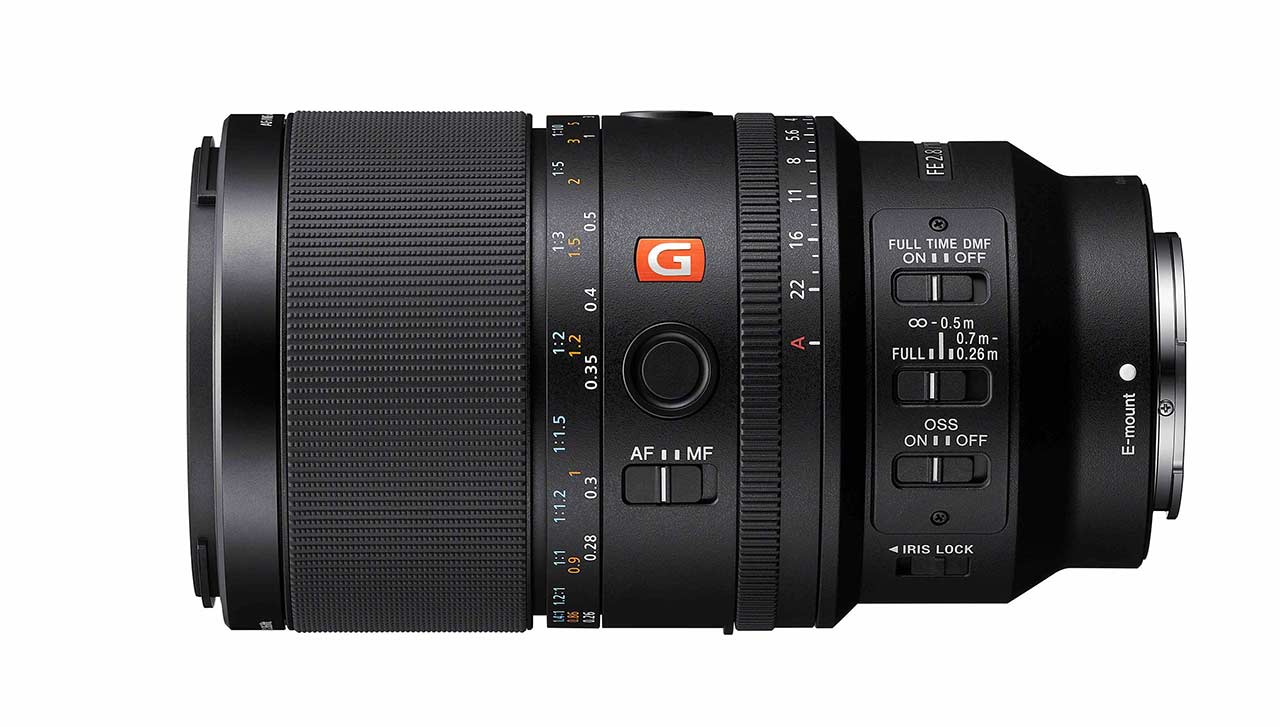
It also features a full-time DMF switch that allows seamless manual fine-tuning of the focus after focusing with autofocus, and a focus range limiter that limits the autofocus operating range according to the shooting distance, improving focusing speed.
High reliability
In terms of reliability, the lens is designed to be dustproof and weather-resistant, making it durable enough to withstand harsh outdoor environments. The front lens element is coated with fluorine, making it resistant to fingerprints, water droplets, oil, and other contaminants, and easy to maintain.
Sony FE 100mm F2.8 Macro GM OSS vs the Sony FE 90mm F2.8 Macro G
This lens has a high level of expressiveness that goes beyond the realm of conventional macro photography, and demonstrates its performance in a wide range of applications, from photographing plants and insects to taking product photography of jewelry and industrial products that take advantage of its high resolution, and even portrait photography. For users who have long awaited a high-performance macro lens, this lens will provide a new photography experience with improvements in all aspects: image quality, AF performance, and operability.
| Lens name | FE 100mm F2.8 Macro GM OSS | FE 90mm F2.8 Macro G OSS |
| Lens construction | 13 groups 17 elements | 11 groups 15 pieces |
| Aspheric Lenses | Super highly aspherical XA x 2 | Aspherical surface x 1 |
| ED glass | ED×2 | Super ED×1/ED×1 |
| Minimum focusing distance | 0.26 m | 0.28 m |
| Maximum magnification | 1.4x (1x or more) Maximum 2.8x when using a teleconverter |
1x (same size) |
| Teleconverter compatible | Compatible (SEL14TC, SEL20TC) | Not supported |
| Focus System | Inner focus, floating focus | Inner focus, floating focus |
| Actuator | XD linear motor (x4) | DDSSM (x2) |
| Linear Response MF | correspondence | correspondence |
| Focus Hold Button | Equipped (x2) | Installed (x1) |
| Focus Range Limiter | mounted | mounted |
| Full-time DMF switch | mounted | Not installed |
| Circular aperture/Aperture blades (number) | Circular aperture/ 11 | Circular aperture/9 |
| Maximum aperture/minimum aperture | 2.8/22 | 2.8/22 |
| Aperture ring/Aperture lock/Click ON/OFF | mounted | Not installed |
| In-lens image stabilization | 5-axis compensation (Yaw/Pitch/ X/Y・Z ) | 2-axis compensation (Yaw/Pitch) |
| Lens coating | Nano AR Coating II | Nano AR |
| Antifouling coating | Fluorine Coating | Not installed |
| Filter diameter | 67mm | 62mm |
| External dimensions | φ81.4 x 147.9mm | φ79 x 130.5mm |
| Mass (approx.) (g) | 646g | 602g |
| Dustproof and water-resistant | Considerate design | Considerate design |